
Everyone has an opinion about which AI is best. Most of those opinions were formed in 2023, repeated in 2024, and are being treated as settled fact in 2026 despite the landscape having changed dramatically in the interim.
Here is the truth: ChatGPT, Claude, and Gemini are all genuinely capable tools in 2026. All three have improved substantially. All three have specific areas where they outperform the others. And the choice between them is not as simple as picking a winner it is about matching the right tool to the right job.
most AI tool reviews skip. We are going to test all three across the scenarios that actually matter to the professionals, marketers, developers, and business owners who use these tools daily writing, coding, research, analysis, image generation, and the emerging category of AI search visibility. We will tell you where each one genuinely wins, where it falls short, and which one deserves to be in your primary workflow in 2026.
Why This Comparison Matters More Than Ever in 2026
The AI tool landscape has changed in ways that make an updated comparison genuinely necessary, not just marginally useful.
ChatGPT has maintained its position as the most widely used AI assistant in the world, but OpenAI's product decisions including the introduction of multiple model tiers and the evolution of GPT-4o's capabilities have created genuine complexity around which version of ChatGPT you are actually using and what it can do.
Claude has emerged as the preferred tool for serious writing, analysis, and long-document work among professionals who have tried multiple AI assistants. Anthropic's focus on nuanced, accurate, thoughtfully structured responses has built a loyal user base that consistently chooses Claude over ChatGPT for demanding professional work.
Gemini has matured significantly from its initially underwhelming reception and now represents Google's most compelling AI strategy, an assistant with the deepest integration into the Google Workspace ecosystem that most professionals already live in, combined with genuinely strong search-grounded responses that leverage Google's unmatched web index.
All three offer free ai tools tiers. All three have paid plans with expanded capabilities. And the best ai tools directory platforms in 2026 consistently list all three as top-tier options because all three genuinely are top-tier options, for different things.
The Testing Framework: How We Compared All Three
Rather than running abstract benchmark tests that do not reflect real professional usage, this comparison evaluates all three tools across six categories that directly reflect how working professionals use AI every day.
Writing quality and range from marketing copy to long-form content to creative work. Research and analysis factual accuracy, source handling, and analytical depth. Coding assistance code generation, debugging, and code review. Business document production proposals, reports, and professional communication. Image generation where each platform has taken meaningfully different approaches. And AI search and visibility is the emerging category that is reshaping how we think about AI tools entirely.
Each category gets a clear verdict, and the final section synthesizes those verdicts into the specific stack recommendation that fits different professional profiles.
Writing Quality The Most Important Battle
For the majority of professionals using AI daily, writing assistance is the primary use case. This is where the differences between ChatGPT, Claude, and Gemini are most pronounced and most practically significant.
ChatGPT for Writing
ChatGPT remains the most versatile best AI tools for writing options for general-purpose writing tasks in 2026. It is fast, capable across a wide range of formats and tones, and has developed a strong capability for short-to-medium length content social media posts, marketing copy, email sequences, product descriptions, and structured business writing.
Where ChatGPT shows its limitations for writing is in longer-form, more nuanced content. Articles and reports that require sustained reasoning, consistent voice, and careful logical development often show a certain formulaic quality that experienced writers recognize immediately. The content is technically competent but lacks the distinctive reasoning quality that makes writing genuinely persuasive or memorable.
For best AI tools for content writing in high-volume marketing contexts where speed and variety matter more than a distinctively sophisticated voice ChatGPT remains a strong primary tool. For content where the quality of the thinking is as important as the quality of the writing, Claude is typically the stronger choice.
Claude for Writing
Claude has established itself as the clear leader in the best ai writing tools category for professional, long-form, and nuanced writing in 2026. Its responses consistently demonstrate stronger logical coherence, more careful attention to the specific nuances of the user's request, and a more natural, less formulaic writing style than its competitors.
For best ai tool for content writing applications blog posts, thought leadership articles, long-form marketing content, and any writing that needs to demonstrate genuine expertise and careful reasoning Claude consistently produces output that requires less editing to reach publication quality than equivalent ChatGPT output.
For best AI tools for writing reports and professional documentation where clarity, logical structure, and careful treatment of complexity are essential, Claude's extended context window and sustained reasoning quality make it the strongest choice. A 10,000-word analysis document produced by Claude maintains coherence and quality from beginning to end in a way that ChatGPT reports often do not.
The question of what is the best AI tool for writing professionally in 2026 has a clear answer for most demanding use cases: Claude. Not by a small margin for serious writing work by a meaningful one.
Gemini for Writing
Gemini has improved substantially as a writing tool and is now competitive with ChatGPT for general-purpose writing tasks. Its particular strength is writing that benefits from real-time web access summaries of current events, content that references recent developments, or writing that needs to incorporate up-to-date facts and figures.
For professionals who want writing assistance deeply integrated into Google Docs and Gmail with Gemini actively suggesting, editing, and drafting within the tools they already use, Gemini's Workspace integration makes it the most frictionless writing assistant for the Google ecosystem. This workflow advantage is significant for teams that live in Google Workspace.
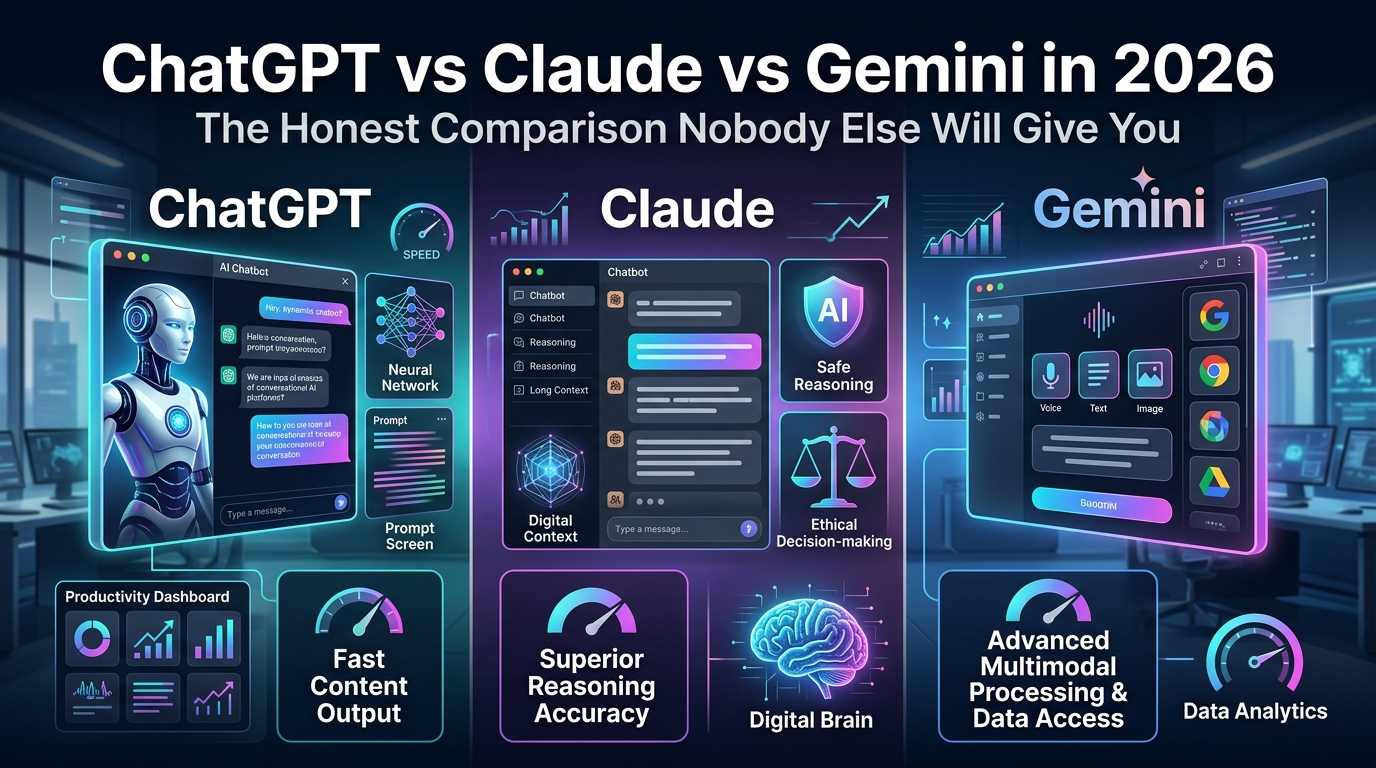
Writing winner: Claude for quality and depth. ChatGPT for speed and volume. Gemini for Google Workspace integration and current-events writing.
Research and Analysis
ChatGPT for Research
ChatGPT's browsing capability gives it access to current information, and its synthesis quality is strong for general research tasks. Where it consistently falls short is in nuanced factual accuracy for complex or specialized topics it has a well-documented tendency to state uncertain information with excessive confidence, which requires users to verify claims independently rather than trusting the output.
For general research briefings, initial landscape surveys, and content that will be verified before publication, ChatGPT produces useful research starting points efficiently. For research that requires precise factual accuracy and careful handling of uncertainty, Claude and Perplexity both outperform it.
Claude for Research and Analysis
Claude's research and analysis capability is strongest for complex analytical tasks where the quality of reasoning matters more than the currency of information. Its ability to maintain coherent analytical threads across long contexts, hold multiple competing frameworks in tension, and produce structured, nuanced analysis of complex problems makes it the preferred ai tools for business analysis tool for many professionals.
Where Claude has historically been weaker than ChatGPT is in real-time web access; earlier versions were entirely training-data-dependent. Claude's search capabilities have improved significantly, though Gemini's deep Google Search integration still provides an advantage for research requiring genuinely current information.
Gemini for Research
Gemini's search-grounded responses represent its clearest competitive advantage for research use cases. Built on Google's web index the most comprehensive available Gemini can access and synthesize current information with a reliability that ChatGPT's browsing mode and Claude's search integration have not yet matched at scale.
For professionals who need AI-assisted research into current market conditions, recent news, evolving regulatory environments, or any topic where the most recent information is critical Gemini is the strongest research option in 2026.
Research winner: Gemini for current information. Claude for analytical depth. ChatGPT for general research breadth.
Proposal Writing and Professional Documents
The specific question of best ai tool for proposal writing and best ai tools for proposal writing deserves dedicated attention because this is one of the highest-stakes AI writing applications in professional contexts where the quality of the output directly affects business outcomes.
ChatGPT for Proposals
ChatGPT can produce competent proposal structures quickly, making it useful for generating initial outlines and section frameworks. The consistent limitation for proposal writing is that ChatGPT's responses tend to be formulaic at the structural level experienced proposal readers can often identify AI-generated sections because they follow predictable patterns that feel generic rather than specifically tailored to the client's situation.
Claude for Proposals
Claude's proposal writing capability stands out specifically because of its ability to maintain client-specific context throughout a long document and produce persuasive reasoning that feels genuinely tailored rather than templated. For complex B2B proposals where the persuasive quality of the argument matters as much as the completeness of the information Claude is the strongest option among the three.
For the specific use case of submitt a tool in professional services, consulting, and agency contexts, Claude's combination of writing quality, logical coherence, and sustained focus on the client's specific situation makes it the clear recommendation.
Gemini for Proposals
Gemini's proposal writing capability benefits from its Workspace integration drafting directly within Google Docs, referencing other documents and data sources in your Drive, and maintaining the formatting conventions of your existing document library. For teams working primarily in Google Workspace, this integration value is real, even if the raw writing quality is somewhat below Claude's for complex proposals.
Proposal writing winner: Claude for quality. Gemini for Workspace-integrated teams. ChatGPT for rapid initial structuring.
Coding and Technical Assistance
ChatGPT for Coding
ChatGPT's coding capability particularly through GPT-4o remains genuinely strong and has been the default recommendation for developer AI assistance for most of the past two years. Code generation, debugging assistance, explaining complex technical concepts, and code refactoring all perform well, and ChatGPT's large developer user base has created a significant ecosystem of coding-specific prompting techniques and workflow integrations.
For AI code review tools use cases where you need AI assistance reviewing code for bugs, security issues, style consistency, and logic errors ChatGPT performs competently across a wide range of languages and frameworks.
Claude for Coding
Claude has emerged as a genuine competitor to ChatGPT for coding assistance in 2026, particularly for complex, multi-file coding tasks and for situations where the explanation of the code is as important as the code itself. Claude's explanations of what code does and why particular implementations were chosen tend to be clearer and more pedagogically useful than ChatGPT's, which matters for developers learning new languages or frameworks.
For ai code review tools applications where the review needs to include substantive explanation and reasoning alongside the identification of issues, Claude's explanatory quality gives it an advantage over ChatGPT for learning and team knowledge-sharing contexts.
Gemini for Coding
Gemini's coding capability has improved substantially and is now competitive with both ChatGPT and Claude for standard coding tasks. Its particular strength is in Google's ecosystem Android development, Google Cloud Platform integrations, and Firebase-related work benefit from Gemini's deep familiarity with Google's own tools and APIs.
Coding winner: ChatGPT for breadth and ecosystem. Claude for explanation quality. Gemini for Google platform development.
AI Image Generation
This category requires a different kind of comparison, because the three tools have taken meaningfully different approaches to image generation.
ChatGPT: DALL-E 3 Integration
ChatGPT's integration with DALL-E 3 provides strong general-purpose ai image generation tools capability directly within the chat interface. DALL-E 3's ability to follow complex, detailed prompts accurately and to render text within images more reliably than most competing models makes it particularly useful for marketing content, presentation visuals, and any image that requires specific design elements to be present.
Claude: Limited Native Image Generation
Claude's native image generation capability is more limited than ChatGPT's DALL-E 3 integration. Anthropic has focused Claude's development on text-based capabilities rather than image generation, and this shows in the image tools available through the standard Claude interface. For teams that need integrated image generation alongside their writing and analysis workflow, this limitation is worth noting.
Gemini: Google's Image Generation
Gemini's image generation, powered by Google's Imagen model, has produced strong results for realistic photographic-style imagery and has improved substantially in its ability to follow detailed prompts. For teams in the Google ecosystem where visual content needs to integrate with other Workspace tools, Gemini's image generation within Google Slides and Google Docs creates workflow advantages that standalone image generation tools do not offer.
Image generation winner: ChatGPT (DALL-E 3) for prompt accuracy and text rendering. Gemini for Workspace-integrated visual content.
AI Search and Visibility The 2026 Differentiator
The emerging category of ai search engine optimization tools and ai visibility tool capabilities is where the three AI systems diverge most significantly in strategic relevance for marketing and business professionals.
What Are AI Search Optimization Tools?
What are ai search optimization tools in the context of ChatGPT, Claude, and Gemini specifically? They are the capabilities these platforms provide for helping businesses understand and improve how they are represented in AI-generated responses a new dimension of visibility that has become strategically important as more users turn to AI assistants rather than traditional search engines for information and recommendations.
ChatGPT's Role in AI Search Visibility
For ai seo tools applications specifically, ChatGPT functions primarily as a content creation and optimization assistant rather than as an indexing or discovery mechanism. Businesses that want to appear in ChatGPT responses need to focus on the quality and discoverability of their web content since ChatGPT's browsing mode retrieves from Bing's index, Bing SEO performance directly influences ChatGPT search visibility.
For best ai seo tools 2026 evaluation, ChatGPT is most valuable as a tool that helps create the content and optimization work that influences AI visibility, rather than as a platform that provides AI visibility analytics or monitoring.
Claude's Role in AI Search Visibility
Claude's approach to AI search is focused on accurate, carefully reasoned responses rather than comprehensive web indexing. For ai tools for seo practitioners, Claude's value is as an analytical and writing tool helping analyze competitive positioning, draft optimized content, and reason through SEO strategy rather than as a real-time search intelligence platform.
Gemini's Search Advantage
Gemini's connection to Google's search infrastructure gives it the most direct relevance for ai search engine optimization tools applications in 2026. Google's AI Overviews which appear at the top of search results for a growing percentage of queries are powered by Gemini, which means that content optimization for AI Overviews is, in effect, optimization for Gemini's responses.
For marketing teams focused on ai seo tools strategy in 2026, understanding how Gemini evaluates and presents content is directly relevant to Google AI Overview performance making Gemini the most strategically important of the three tools specifically for search visibility purposes.
AI search visibility winner: Gemini for direct Google integration. ChatGPT for content creation supporting AI visibility. Claude for analytical support.
Finding All Three Tools: The AI Tool Directory Angle
A practical consideration for professionals building their AI stack is knowing where to evaluate and compare these tools alongside the broader landscape of AI alternatives. This is where ai tool directory platforms have become genuinely useful providing organized, comparative information about AI tools across categories that makes evaluation faster and more comprehensive than researching individual tools separately.
A well-maintained best ai tools directory in 2026 allows professionals to browse tools by specific use case ai tools for marketing, ai tools for business, ai writing tools, coding assistants and compare ChatGPT, Claude, and Gemini against each other and against specialized alternatives that might outperform the major three for specific narrow use cases.
Ai tool directories have also become important for AI tool developers who want their products discovered alongside the major players. The ai tools directory list on major platforms typically includes ChatGPT, Claude, and Gemini as reference points in every relevant category, which helps users understand how specialized tools compare to the established benchmarks. For any developer looking to submit ai tool listings to major directories, being explicitly positioned relative to these three major tools rather than in isolation consistently improves discoverability and conversion.
The major ai tool directory platforms worth monitoring for updates to comparative assessments of these three tools include There's An AI For That, Futurepedia, Toolify, and AITopTools all of which maintain regularly updated comparisons that reflect current capability rather than 2023-era assessments.
The Marketing and Business Use Case Stack
For professionals using these tools specifically for ai marketing tools and ai tools for business applications, here is the practical stack recommendation.
Primary content creation: Claude for long-form, strategic content; ChatGPT for high-volume shorter content and rapid iteration. Both have free ai tool tiers worth starting with before committing to paid subscriptions.
Research and market intelligence: Gemini for current market conditions and competitor monitoring; Claude for deep analysis of the research gathered.
SEO and content optimization: Gemini for AI Overview optimization strategy; ChatGPT for bulk content optimization with AI assistance; Claude for the analytical framework underlying your SEO strategy.
Proposals and client documents: Claude as primary tool for all high-stakes professional documents where quality is more important than speed.
Coding and technical marketing work: ChatGPT for most development assistance; Gemini for anything in the Google ecosystem.
For teams evaluating these tools through any Best ai tool directory, the key insight is that the optimal configuration is not a single winner but a deliberate stack where each tool is used for the specific category where it performs best.
Free Tier Comparison: What You Actually Get
All three tools offer meaningful free AI tool access, but with important differences in what is available without a subscription.
The ChatGPT free tier provides access to GPT-4o with usage limits, DALL-E image generation with limited daily credits, web browsing with some restrictions, and the GPT Store for accessing specialized custom GPTs. For most professional evaluation purposes, the free tier is sufficient to test ChatGPT's capabilities before committing to the Plus plan at $20 per month.
Claude free tier provides access to Claude Sonnet with usage limits, long context window capability even on the free plan, and the full conversational quality that makes Claude distinctive. The free tier's usage limits are the primary constraint rather than capability restrictions; you get full-quality Claude, just with a daily message limit.
Gemini free tier provides access to Gemini with web search grounding, basic Google Workspace integration, and image generation. The Gemini Advanced subscription unlocks the most capable model and the deepest Workspace integrations.
Final Thoughts:
The honest answer is that there is no single winner in 2026, and any guide that tells you otherwise is oversimplifying a genuinely complex landscape.
Claude wins for writing quality, analytical depth, long-form content production, proposal writing, and any task where the sophistication of the reasoning matters as much as the quality of the prose. It is the best ai tool for content writing for demanding professional applications.
ChatGPT wins for breadth, ecosystem, image generation via DALL-E 3, developer tooling, and general-purpose versatility. It remains the most capable single tool for professionals who need one AI to cover the widest possible range of tasks adequately.
Gemini wins for Google Workspace integration, real-time search-grounded responses, AI Overview optimization relevance, and any use case where being deeply embedded in Google's ecosystem provides genuine workflow advantage.
The professionals achieving the best results with AI in 2026 are not the ones who have picked the best single tool. They are the ones who have built a deliberate stack using each tool where it genuinely excels, not defaulting to a single tool for everything because switching contexts feels like friction.
That stack typically looks like this: Claude as the primary writing and analysis tool, ChatGPT as the versatile secondary for image generation and coding, and Gemini as the research and search-visibility tool for anyone operating seriously in the Google ecosystem.
Start with the free tiers. Test all three on the specific tasks that matter most to your actual workflow. The differences become immediately apparent when you run the same demanding professional task through all three rather than relying on benchmark scores or other people's general impressions.
The right AI tool is the one that produces the result your work actually needs, and in 2026, you have three genuinely excellent options to choose between for different parts of that work.
Found this helpful? Share it with others who might benefit from these insights!
Submit Your AI Tool