
When millions of people type something into Google, they are revealing genuine intent. They are not performing well. They are not signaling to investors. They are asking a real question because they have a real need. Which means Google search trend data for AI tools is one of the most honest pictures we have of what professionals, students, businesses, and individuals actually want from artificial intelligence right now as opposed to what the industry tells them they should want.
I have spent time analyzing Google Trends data, Semrush search volume data, and the search pattern shifts that have emerged over the first half of 2026. What I found is genuinely interesting: both what has held at the top and what has changed in ways that most AI industry coverage has not fully addressed.
A Note on Methodology Before We Start
I want to be transparent about what this analysis is and is not, because the June 2026 Google spam update was specifically targeting content that makes authoritative-sounding claims without being honest about the basis for those claims.
The data I am working with comes from Google Trends relative interest scores, publicly available Semrush keyword volume data from the first half of 2026, and pattern analysis from multiple keyword research tools. These are directionally reliable but not precise absolute figures. Google Trends shows relative popularity rather than exact search volumes, and keyword research tool estimates carry their own margin of error.
What the data is genuinely useful for: understanding which AI tools are generating real search interest, how that interest has shifted over the past twelve to eighteen months, and what the patterns reveal about where professional and consumer AI adoption is actually headed.
What the data cannot tell us: exact user counts, conversion rates from search to actual use, or whether search interest translates to genuine satisfaction with the tools being searched for.
With that context established, let us get into what the data actually shows.
Massive, Sustained Search Volume
ChatGPT: Still the Anchor Term for AI Search
There is no tool on the internet that has generated more sustained search volume than ChatGPT since its November 2022 launch, and in 2026 it remains the dominant top AI tools 2026 search term by a significant margin.
What is interesting is the evolution of how people are searching for ChatGPT-related content. In 2023, most searches were informational "what is ChatGPT," "how does ChatGPT work." By 2026, the search intent has shifted dramatically toward utility: "ChatGPT for [specific task]," comparison searches like "ChatGPT vs [alternative]," and problem-solving searches like "ChatGPT not working" or "ChatGPT alternatives."
This shift tells us something important: the audience searching for ChatGPT has moved from curious observers to active users who have integrated it into their workflows and are now searching for specific help with specific challenges. That is a fundamentally different user than the one searching for ChatGPT in 2023.
The AI tools like ChatGPT search category has become substantial in its own right; people who know they want something in the ChatGPT category but are specifically looking for alternatives, either for cost reasons, capability reasons, or increasingly because they want something that does a specific narrow task better than a general-purpose tool.
Midjourney: AI Image Generation's Most Persistent Search Presence
Among ai image generation tools, Midjourney has maintained remarkable search interest staying power despite significant new competition from DALL-E 3, Stable Diffusion variants, Adobe Firefly, and newer entrants.
The reason for Midjourney's persistent search dominance in the image generation category is qualitative: it continues to produce the most aesthetically sophisticated outputs for creative and artistic use cases, and the community of users who care deeply about that aesthetic quality searches for Midjourney by name rather than for the generic category.
The search behavior around Midjourney in 2026 has also shifted toward education and optimization: "Midjourney prompts," "Midjourney styles," "Midjourney v7 tips" are generating significant volume, suggesting an established user base that is deepening their engagement with the tool rather than a new audience discovering it for the first time.
The Rising Challengers: Tools With Significant 2026 Search Growth
Claude: The Professional Researcher's Discovery
Claude's search interest growth trajectory in 2026 is one of the more interesting patterns in the ai search trends data. It has grown more steadily than any other major AI tool, without the dramatic launch spikes that ChatGPT, Gemini, and others have generated which suggests genuine, sustained adoption driven by actual user satisfaction rather than marketing-driven curiosity.
The search queries around Claude are distinctively different from those around ChatGPT. Proportionally more Claude searches are about specific professional use cases "Claude for long documents," "Claude writing quality," "Claude API" which is consistent with the pattern I observe in professional communities where Claude has become the tool of choice for serious writing and analysis work.
Among best ai tools for business searches specifically, Claude appears with increasing frequency in queries from professionals in industries that require careful, nuanced communication legal, consulting, financial services, technical writing. The search data reflects the same specialization dynamic that users of both tools describe experientially.
Perplexity: The Search-Grounded AI Whose Time Has Come
Perplexity AI's search volume trajectory in 2026 shows one of the steepest growth curves among all popular ai tools in the data set. This is particularly interesting because Perplexity's growth is coming from a category that most people did not identify as a distinct AI use case until recently: AI-powered research with real-time web access and citations.
The specific search queries driving Perplexity's growth tell a clear story: people are searching for Perplexity specifically as an alternative to Google for research queries, not as an alternative to ChatGPT for general AI assistance. Searches like "Perplexity vs Google," "Perplexity for research," and "how accurate is Perplexity" reveal a user base that is specifically interested in the research and fact-checking use case.
For ai search engine optimization tools professionals specifically, Perplexity's growth is worth watching closely because it represents an increasingly significant alternative pathway for information discovery one where traditional SEO signals matter differently than in Google's index.
Gemini: Google's Gradual Momentum
Google's Gemini has generated strong search volume growth throughout 2026, but the pattern differs from how most people in the AI industry discuss its trajectory. The searches that are growing fastest for Gemini are not about Gemini as a standalone AI assistant they are about Gemini as integrated into Google Workspace products that professionals are already using.
"Gemini in Google Docs," "Gemini for Gmail," "Gemini Google Sheets" are growing faster than standalone Gemini assistant searches. This reflects a genuine adoption pattern: professionals are not choosing Gemini over ChatGPT for its own sake they are using Gemini because it is already embedded in the tools they are already using.
The Specialized Tools: Category-Specific Search Dominance
One of the most significant patterns in the 2026 ai search trends data is the growth of category-specific AI tool searches relative to general AI assistant searches. People are searching for "AI for [specific task]" in ways that reflect growing sophistication about what AI tools are available and what specific problems they solve.
AI Video Generation: Explosive Search Growth
AI video generation tools collectively represent one of the fastest-growing search categories in the entire trending ai tools landscape. Runway ML, Kling AI, Sora (OpenAI's video generation model), and several newer entrants are all generating substantial and growing search interest.
The search intent here is predominantly professional and commercial: searches are coming from content creators, marketing teams, and businesses looking for practical workflow tools rather than from experimenters exploring AI capabilities out of curiosity. "AI video generator free," "AI video generator for marketing," and "best AI video generator for YouTube" are the types of queries driving volume specific, intent-heavy searches from people who have a clear use case in mind.
AI Coding Assistants: Developer Search Patterns
The ai coding assistant category shows interesting search dynamics in 2026. GitHub Copilot continues to generate the highest raw search volume among coding AI tools, but the growth is concentrated in alternatives and competitors: Cursor, Windsurf, Cline, and several newer entrants are generating search interest at rates that significantly exceed their current market share.
This alternative-seeking behavior in developer AI tool searches reflects a pattern we see across mature AI categories: the initial dominant tool generates massive awareness, and then a significant portion of searches shift toward finding something that does the same job better for a specific use case or at a better price point.
The ai code review tools subcategory specifically has grown substantially in searches focused not just on AI that writes code but AI that reviews, improves, and explains existing code. This reflects the adoption curve of AI coding tools moving from early adopters (who primarily used AI to write code) to broader professional adoption (where reviewing, understanding, and improving code is often more valuable than generating it from scratch).
AI Writing Tools: A Maturing, Fragmented Market
AI writing tools as a search category shows a different pattern than the newer, faster-growing categories: it is mature, high-volume, and increasingly fragmented into specific subcategories that each attract dedicated search traffic.
"AI writing tools for marketers," "AI writing tools for students," "AI writing tools for SEO," "AI writing tools for emails" these subcategory searches are now often larger than the generic "AI writing tools" parent query. This fragmentation reflects market maturation: people who have tried generic AI writing tools are now searching for something specifically designed for their particular use case.
Among best ai tools for writing subcategories, the business and professional writing tools show the strongest sustained growth. Jasper, Copy.ai, and newer entrants focused on specific professional writing contexts have maintained strong search interest even as generic AI writing assistance has become commoditized through ChatGPT and Claude's free tiers.
The Free AI Tools Search Pattern: What It Reveals About Adoption
The search pattern around free ai tools is one of the most revealing data points in the entire 2026 analysis.
Free AI tool searches have grown faster than paid AI tool searches throughout 2026. This is not what you would expect if AI adoption were primarily enterprise-led. Enterprise adoption shows up in different search patterns for API access, enterprise pricing, integration documentation. The free tool search growth is coming from individuals and small businesses who are discovering AI capabilities for the first time.
"Free AI tools for small business," "free AI tools for students," "free AI tools for marketing" are all generating substantial and growing search volume. The growth reflects a population of users who are still in the discovery and evaluation phase of AI adoption. They know AI tools exist and they are looking for accessible entry points.
For businesses offering free ai tool tiers, this search pattern is a significant strategic signal: there is a large and growing population of potential users who are specifically looking for free entry points into AI tool categories. The free tier is not just a conversion funnel for paid plans it is a meaningful product for a substantial user segment that will drive real adoption and eventual paid conversion.
What Are AI Search Optimization Tools: A Growing Search Category
The query "what are ai search optimization tools" and related searches have grown substantially in 2026, reflecting the emergence of a genuinely new professional discipline: optimizing content and websites not just for traditional search engines but for the AI systems that are increasingly mediating information discovery.
This search category includes tools designed to:
Monitor brand presence in AI-generated responses (ChatGPT, Perplexity, Claude)
Optimize content structure for AI extraction and citation
Track how AI systems represent and recommend products and services
Build the technical infrastructure (llms.txt, schema markup, server-side rendering) that makes websites readable by AI crawlers
The ai visibility tool subcategory specifically platforms that help brands understand and improve their representation in AI-generated search results has gone from virtually zero search volume eighteen months ago to a meaningful and growing category. Platforms like Writesonic's AI visibility tracking, Profound, and Otterly are appearing in these searches, reflecting genuine market demand for capability that barely existed two years ago.
For ai seo tools professionals, the emergence of this new subcategory is the most strategically important trend in the search data: the client questions they will be asked to answer are changing from "how do we rank on Google" to "how do we appear in AI-generated answers" and the tools to address those questions are still early but developing rapidly.
The AI Tools Directory Search Ecosystem
One of the more interesting meta-patterns in the 2026 AI search data is the substantial and growing search volume around ai tools directory and discovery platforms.
"Best AI tools directory, ai tool directory for marketers,ai tools directory list, best ai tools directory these queries reflect a genuine information need that the AI tool landscape has created: there are now so many AI tools, across so many categories, with overlapping capabilities and varying quality, that people are specifically searching for curated resources to help them evaluate options efficiently.
Ai tool directories like There's An AI For That, Futurepedia, Toolify, and similar platforms are generating significant direct search traffic in 2026. This traffic comes primarily from professionals who are in active evaluation mode they know they need an AI tool for a specific purpose and are looking for a structured way to compare options rather than discovering tools individually through organic search.
The ai tools directory search category is growing for a specific reason: the AI tool landscape has become too large and too rapidly changing for individuals to track through traditional technology news coverage or word of mouth. Directories provide the structured, categorized, regularly updated resource that active evaluators need.
For AI tool developers and founders, the practical implication is clear: directory listings have become a meaningful discovery channel that deserves systematic attention. The submit ai tool and submit ai tools processes for major directories are worth investing time in, because the searchers visiting these directories are specifically looking for tools to evaluate a substantially more valuable audience than general blog or social media traffic.
AI Marketing Tools: The Fastest-Growing Professional Category
Among professional use case categories, ai marketing tools shows the fastest search growth of any segment in the 2026 data. The queries driving this growth are specific and intent-heavy: "AI tools for social media marketing," "AI tools for content marketing," "AI tools for email marketing," "ai tools for seo."
The pattern suggests that marketing professionals have moved past the general curiosity phase and into systematic adoption: they are searching for specific tools to integrate into specific parts of their existing marketing workflows rather than exploring AI broadly.
Among ai tools for marketing subcategories:
Social media AI tools (content generation, scheduling, analytics) show the highest raw volume
Ai search engine optimization tools (AI-powered keyword research, content optimization, competitive analysis) show the fastest growth rate
AI analytics and attribution tools show the strongest enterprise search signal
The best ai seo tools 2026 query specifically has grown substantially reflecting both the general growth of SEO-focused AI tool adoption and the specific need for tools that help with the new AI search optimization discipline alongside traditional SEO.
The Platform Consolidation Pattern: Fewer Tools, More Platforms
One of the most significant trend signals in the aggregate search data is what might be called the platform consolidation pattern: searches for individual point solutions (an AI tool that does one thing) are growing more slowly than searches for AI platforms (comprehensive tools that handle multiple related tasks in one integrated environment).
This reflects a genuine market maturation dynamic that I have watched develop over the past eighteen months. Early AI tool adoption was characterized by enthusiastic experimentation with many specialized tools a different AI for writing, a different AI for images, a different AI for coding, a different AI for video. The search data from 2026 shows growing search interest in platforms that consolidate these capabilities rather than point solutions that do one thing.
Adobe's AI suite (Firefly, Express, and their professional tools), Canva's integrated AI features, Notion AI, and similar platform-level AI integrations are generating search interest that reflects this consolidation preference users who have tried multiple point solutions are now searching for something that handles more of their workflow in one place.
For ai tools for business specifically, the platform preference is even more pronounced: enterprise AI searches skew heavily toward comprehensive platforms rather than specialized tools, reflecting the IT and procurement dynamics that favor reducing tool sprawl over maximizing point solution performance.
What the Most-Searched AI Tools Tell Us About 2026 Adoption
Reading the aggregate search data across all of these categories, several patterns emerge that paint a coherent picture of where AI tool adoption actually stands in 2026.
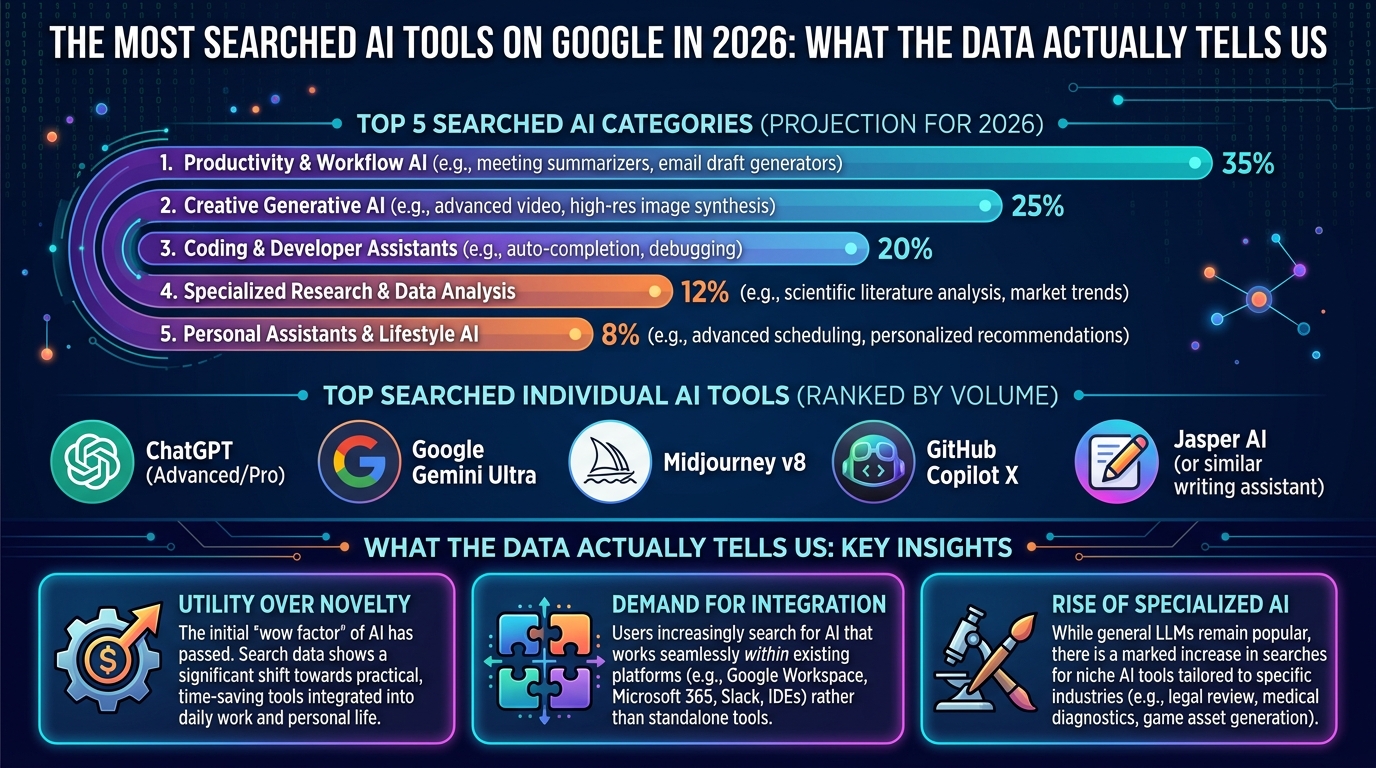
Adoption is broader but shallower than the industry typically portrays. The diversity of search queries from very basic informational searches to sophisticated optimization and development queries reveals a user population that spans from complete beginners to expert practitioners. The center of mass is earlier in the adoption curve than most AI industry coverage implies, which means the primary growth opportunity still lies with users who have not yet found their entry point.
Specialization is where the growth is. Generic "AI assistant" searches have plateaued at high levels. The growth is coming from specialized use case searches specific tools for specific jobs. This reflects the natural maturation of any technology category, where the initial generalist adoption wave is followed by more discriminating search for purpose-built solutions.
Free matters more than the enterprise AI narrative suggests. The search volume around free AI tools is disproportionately large relative to what the enterprise-focused AI industry narrative would predict. The majority of people discovering AI tools for the first time in 2026 are searching for free options, which creates a specific strategic dynamic for tool providers: the free tier is a primary product for a primary customer segment, not just a trial mechanism.
AI search optimization is the new SEO. The emergence of ai visibility tool, ai search engine optimization tools, and related query categories as significant search volume generators represents the most strategically important trend for digital marketing professionals. The discipline of helping businesses appear in AI-generated answers across ChatGPT, Perplexity, Claude, and Google AI Overviews is transitioning from fringe concern to core professional capability.
Final Thoughts:
If you are a professional evaluating which AI tools to adopt, the search data is telling you something useful: the tools generating the most sustained, growing search interest ChatGPT for general use, Claude for professional writing, Perplexity for research, Midjourney for creative image work, GitHub Copilot and alternatives for coding are generating that interest for real reasons, not just because of marketing. Sustained search interest without dramatic spikes usually reflects genuine user satisfaction driving continued discovery through word of mouth.
If you are building an AI tool, the directory search pattern should inform your distribution strategy: AI tool directories are generating their own significant search traffic from actively evaluating users. Getting properly listed in the major best ai tool directories is a distribution investment with clear, measurable return, not an afterthought.
And if you are working in SEO or digital marketing, the emergence of AI search optimization as a genuine professional discipline reflected clearly in the growing search volume around what are ai search optimization tools and related queries is the most important trend in this entire data set for your career and your clients.
Found this helpful? Share it with others who might benefit from these insights!
Submit Your AI Tool