
A bootstrapped fundraising strategy means you fund your company yourself first — through savings, early customer revenue, or support from friends and family — before you ever approach an outside investor. You prove the business works, build real traction, and only then raise external capital, on your own terms rather than out of necessity. This guide breaks down why it works, the data behind it, and exactly how to do it.
I've read a hundred "founder success" threads, and most of them skip this part entirely. Let's fix that.
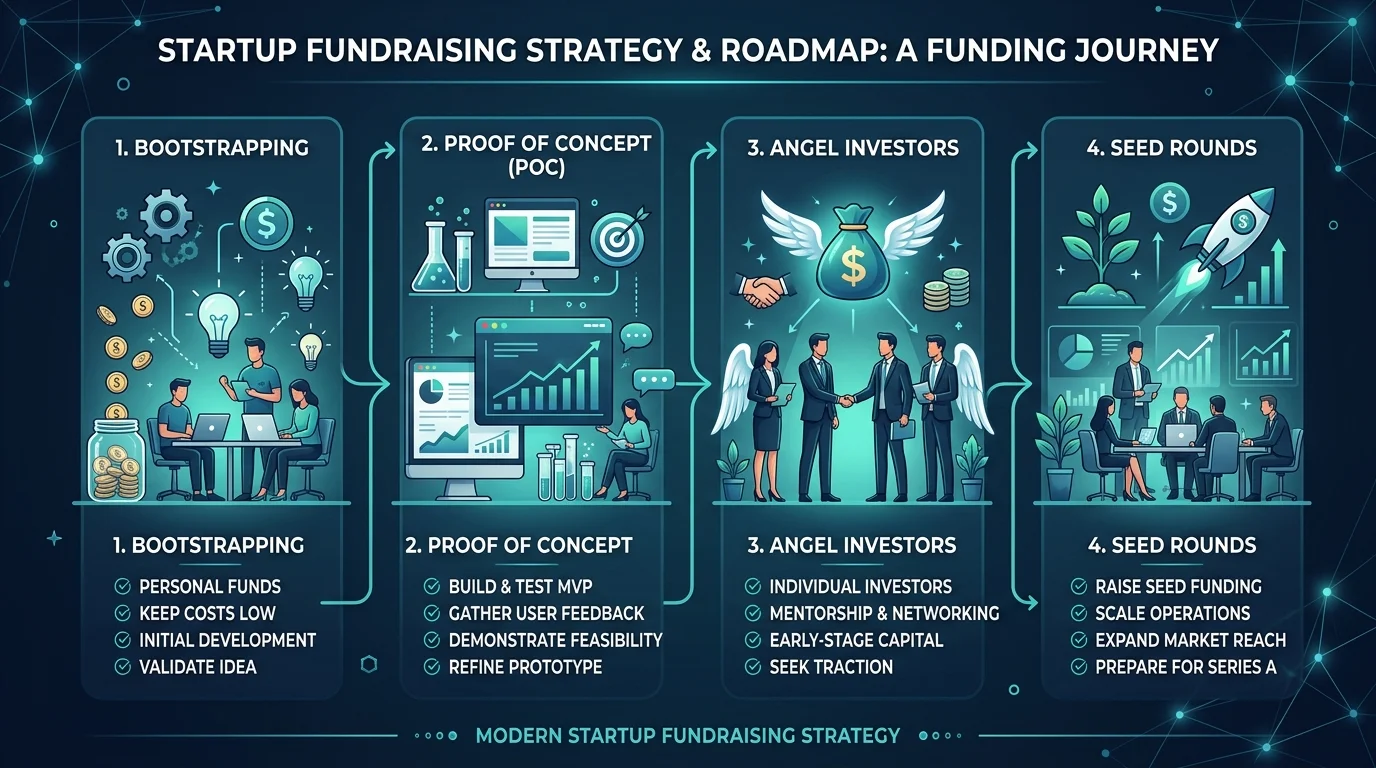
What Is a Bootstrapped Fundraising Strategy?
Let me break this down simply, because the term gets thrown around a lot.
This is fundamentally different from the "raise-first" playbook most venture capital content pushes on you. You're not betting your company on a stranger's belief in your slide deck. You're betting on your own execution — then bringing in outside money once you have proof, not promises.
Before you get to fundraising conversations at all, though, you need the numbers to back you up. That's why getting your startup financial modeling right early on matters just as much as the fundraising strategy itself — investors will ask for it either way.
Bootstrapping vs. Venture Capital: A Quick Comparison
You'll make a better decision if you see the trade-offs side by side.
Factor | Bootstrapping | Venture Capital |
|---|---|---|
Founder equity | You keep 100% (until you choose to raise) | Typically under 50% remaining after Series A (Carta, 2024) |
Growth speed | Slower, revenue-paced | Faster, capital-fueled |
Control | Full decision-making power | Shared with investors/board |
Risk profile | Lower financial risk, higher personal pressure | Higher burn, less personal cash risk |
Best fit | SaaS, services, content, low-capital tech | Hardware, biotech, deep tech, winner-take-most markets |
Fundraising leverage | High — you raise from proven traction | Low early on — you're raising on potential |
Why This Approach Is Winning Right Now
I want to hit you with numbers, because vibes don't pay rent.
Only about 0.05% of U.S. startups ever raise venture capital, according to Fundera's financing data.
Per SaaS Capital's 2025 benchmark survey of 1,000+ private B2B SaaS companies, bootstrapped businesses between $3M–$20M ARR posted median growth around 15–20%, with Net Revenue Retention near 103%.
Carta's 2024 data shows founders typically own less than 50% of their company after a Series A round.
A ChartMogul analysis of 2,500+ SaaS companies found top-quartile bootstrapped businesses reach $1M ARR only about four months slower than VC-backed peers — while keeping 100% equity.
So when you bootstrap first, you're not just being scrappy. You're protecting your founder equity and building leverage for later.
Real Companies That Proved This Works
I'm not going to sell you a theory with no receipts.
Mailchimp bootstrapped for roughly 20 years with zero venture capital. It grew to $700 million in revenue and sold to Intuit for $12 billion in 2021.
GitHub bootstrapped from 2008 to 2012, then raised $100 million from Andreessen Horowitz — on its own terms, with traction already proven. Microsoft acquired it for $7.5 billion in 2018.
Basecamp has stayed profitable for over 20 years without taking outside money.
You see the pattern? None of these founders needed permission to start. They needed customers who paid them.
Step-by-Step: How to Bootstrap Your Fundraising Strategy
Here's the tactical part — what you can actually apply today.
Step 1: Validate Before You Build Anything
Talk to real potential customers, not friends being polite. Find one person willing to pay before you write a line of code.
Step 2: Ship the Smallest Version That Makes Money
Build a minimum viable product that solves one real problem and earns a dollar. Speed beats polish here.
Step 3: Track Your Cash Weekly
Your burn rate and your runway decide whether you survive. Check them every week, not every month.
Step 4: Grow Through Revenue Signals, Not Assumptions
Renewals and upgrades tell you whether you've found product-market fit — more honestly than any investor feedback.
Step 5: Raise Only When It Speeds Things Up
Raise when demand outpaces cash flow, or a market window is closing fast. Walk in with monthly recurring revenue, real customer acquisition cost numbers, and a growth curve that argues for itself.
Non-Dilutive Funding Options If You Don't Want to Raise Equity
You don't always have to sell ownership to get capital. Options include:
Revenue-based financing — repay as a percentage of revenue, not a fixed schedule
Venture debt — a loan structured for startups with recurring revenue, letting you bridge to your next milestone without further dilution
SAFE notes — a lighter instrument than a full priced round, often used as a bridge
If you're running lean while you bootstrap, the right software stack matters too — see our roundup of the best AI tools for freelancers for ways solo and small founding teams cut costs without cutting corners.
The Honest Trade-Off
Bootstrapping is slower, most of the time. You won't out-hire a company that just raised $20 million, and you'll feel every payroll cycle more directly.
In return, you get capital efficiency, real financial discipline, and a business that answers to customers instead of a board. For most founders, that trade-off is worth it.
Frequently Asked Questions
Is bootstrapping better than raising venture capital?
Neither is universally better. Bootstrapping suits businesses that can grow steadily with limited capital; venture capital suits businesses that need to scale fast or require heavy upfront investment.
How long should a startup bootstrap before raising money?
There's no fixed timeline. Most founders bootstrap until they have clear proof — steady revenue, retention, consistent growth — before considering outside funding.
Does bootstrapping mean avoiding all outside funding forever?
No. It means proving the business first, then raising selectively and on stronger terms if it makes sense.
What businesses are best suited to bootstrapping?
SaaS, B2B software, digital services, content businesses, and marketplaces — models that can generate revenue with low upfront capital.
What if my industry needs more capital upfront?
Capital-intensive sectors like hardware, biotech, and deep tech typically need earlier VC funding because build costs exceed what bootstrapping can support.
Can I bootstrap and still raise VC later on better terms?
Yes — this is common. Investors prefer founders who've already proven demand, since a bootstrapped company with consistent growth is a stronger bet than an idea on a slide.
Found this helpful? Share it with others who might benefit from these insights!
Submit Your AI Tool