
Startup booted financial modeling is the practice of forecasting a company's revenue, expenses, cash flow, burn rate and runway using income the business generates itself rather than venture capital. The phrase is a common variant of "bootstrapped financial modeling" and describes the same discipline. Founders use it to answer one question: will this business reach profitability before it runs out of cash? A bootstrapped model prioritises cash timing over projected profit, because a company can grow revenue and still fail on collection timing. This guide covers the definition, the metrics that matter, a worked runway calculation, 2026 unit economics benchmarks and a step-by-step build process.
What is startup booted financial modeling?
Startup booted financial modeling is a forecasting method in which a founder projects revenue, operating expenses, cash movement, burn rate and runway on the assumption that no outside funding will arrive. "Booted" is a widely used shorthand and misspelling of "bootstrapped," so the two terms are interchangeable in practice.
The model has a different purpose from a venture-backed forecast. A VC-oriented model is usually built to support a fundraising narrative. A bootstrapped model is built to keep the founder accurate about what the business can afford this quarter. Every hire, every marketing channel and every software subscription has to be paid for out of trading income, which makes the forecast an operating tool rather than a presentation asset.
At minimum, a working model produces four outputs:
A monthly revenue forecast built from volume and price drivers
A monthly operating expense and headcount plan
A cash flow statement showing when money actually lands and leaves
A runway figure and a zero-cash date
Treat the cash flow output as the primary statement and the profit and loss as a secondary read. Profit is an accounting outcome. Cash is the constraint that ends companies.
Why bootstrapped founders need a financial model
Running out of cash is the mechanism of startup failure, not the cause. CB Insights analysed 431 venture-backed companies that shut down after 2023 and found that "ran out of capital" appeared in 70% of cases, while poor product-market fit appeared in 43%, bad timing in 29% and unsustainable unit economics in 19% (CB Insights, 2026).
That distinction matters for a bootstrapped company. An empty bank account is a lagging indicator that arrives months after the underlying problem started. A model that tracks unit economics and cohort retention surfaces the same problem while there is still time to change pricing, cut a channel or slow hiring.
The second reason is optionality. A founder who can show a clean revenue-based model is in a stronger position if a lender or investor is ever approached later. Financial discipline demonstrated over eighteen months of actuals carries more weight than an optimistic projection.
Cost control is the other half of the equation. Software spend is one of the few line items a bootstrapped founder can cut this week rather than next quarter, and consolidating overlapping subscriptions is usually the fastest available saving. AIToolSync maintains a directory of AI tools for freelancers and solo operators that covers the free and low-cost options worth auditing before the next renewal cycle.
Bootstrapped vs venture-backed financial models: what actually differs
The two model types share the same accounting engine and diverge on assumptions, audience and priority metric.
Dimension | Bootstrapped model | Venture-backed model |
|---|---|---|
Primary audience | The founder and the operating team | Investors and the board |
Funding assumption | No new capital arrives | A future round is assumed |
Priority statement | Cash flow statement | Profit and loss / ARR growth |
Growth posture | Spend follows revenue | Spend precedes revenue |
Headline metric | CAC payback period and runway | Growth rate and LTV:CAC |
Forecast bias | Conservative, built on trailing actuals | Ambitious, built on target trajectory |
Typical horizon | 12 to 18 months at monthly detail | 36 to 60 months |
Failure mode | Understating collection lag | Assuming the next round closes |
Requires a balance sheet | ✅ Yes, for working capital timing | ✅ Yes, for dilution and cap table |
Tolerates negative unit economics | ❌ No | ✅ Temporarily |
The practical consequence: a bootstrapped founder should forecast conservatively using historical data and a realistic growth rate, because an optimistic revenue line creates a cash shortfall rather than a missed target (Standard Ledger).
Which metrics belong in a startup booted financial model?
Nine metrics carry the model. Everything else is supporting detail.
Metric | Formula | 2026 benchmark | Source |
|---|---|---|---|
Gross burn | Total monthly cash out | Include founder salaries | Calculator Catalog |
Net burn | Gross burn minus revenue | Use this for runway | ToolStrategyHub |
Cash runway | Cash ÷ net burn | 18 to 24 months post-raise | PipelineRoad |
LTV:CAC | LTV ÷ CAC | 3:1 minimum, 4:1 to 6:1 top quartile | Digital Applied |
CAC payback | CAC ÷ (monthly ARPU × gross margin) | Under 12 months self-serve, 12 to 18 sales-assisted, 18 to 24 enterprise | Dodo Payments |
Gross margin | (Revenue − COGS) ÷ revenue | 78% SaaS median | SaaS Buyer Guide |
Churn rate | Customers lost ÷ starting customers | Compute monthly, by cohort | Dodo Payments |
Net revenue retention | Expansion minus contraction and churn | Above 100% target | Dodo Payments |
Default alive status | Projected profitability month vs zero-cash month | Binary verdict | Mercury |
Two calibration points worth knowing. Only 44% of SaaS companies actually reach the widely cited 3:1 LTV:CAC threshold, so a ratio slightly under it is common rather than fatal (SaaS Buyer Guide). And the most frequent calculation error is computing lifetime value on revenue instead of gross margin, which inflates the ratio for every company that makes it (Digital Applied).
How to calculate runway and default alive status
Cash runway equals current cash divided by monthly net burn. Gross burn is total monthly spend ignoring revenue. Net burn is gross burn minus revenue, and net burn is the figure to use for runway (ToolStrategyHub). Founder salaries, benefits, taxes and stipends all belong in gross burn. Leaving them out produces a runway number that is wrong in the optimistic direction (Calculator Catalog).
Worked example
Input | Before two new clients | After two new clients |
|---|---|---|
Cash on hand | $60,000 | $60,000 |
Monthly revenue | $12,000 | $15,000 |
Monthly expenses | $17,000 | $17,000 |
Net burn | $5,000 | $2,000 |
Runway | 12 months | 30 months |
Two closed deals moved runway by eighteen months without a single change to the cost base. That leverage is the reason bootstrapped models weight revenue timing so heavily.
The default alive test
Paul Graham's framework asks whether a company will reach profitability before cash runs out at its current growth rate and spending level. A company that will is default alive. A company that will not is default dead (Mercury). Read the original essay, Default Alive or Default Dead?, for the full argument.
Running the test honestly requires two rules. Use the trailing three-month growth rate rather than the planned rate, because a plan is not yet a trajectory. And keep the revenue and expense lines clean on a gross versus net basis (Vectig). Step the model forward month by month, compounding both lines, and watch for whichever event arrives first: the month revenue covers expenses, or the month cash crosses zero.
Why CAC payback matters more than LTV:CAC for bootstrapped startups
CAC payback period should be the headline unit economics metric in a bootstrapped model, ahead of LTV:CAC. The reason is cash timing.
LTV:CAC is a long-horizon ratio that describes eventual return, not when the money comes back. A company with a 28-month payback is effectively pre-financing more than two years of customer value before seeing a dollar of gross profit return (Fiscallion). A venture-backed company can fund that gap from its balance sheet. A bootstrapped company funds it from working capital it does not have.
The spread is wide enough to matter. McKinsey's analysis of more than 100 public SaaS companies found a median payback of 16 months for the top quartile and 47 months for the bottom quartile (Fiscallion). Two companies can post identical LTV:CAC ratios and have completely different capital requirements based on payback speed (Dodo Payments).
Practical rule for a bootstrapped model: cap acquisition spend so that blended CAC payback stays inside the company's cash conversion cycle. If customers pay annually up front, a longer payback is survivable. If they pay monthly, it is not.
This is also why organic acquisition channels carry more weight in a bootstrapped model than a funded one. Search and content compound without a monthly media budget, which shortens blended payback across the whole customer base. The best AI SEO tools for search optimization covers the software side of building that channel, and the wider AI marketing tools roundup maps the paid alternatives so the CAC line in your model reflects real channel costs.
How to build a startup booted financial model step by step
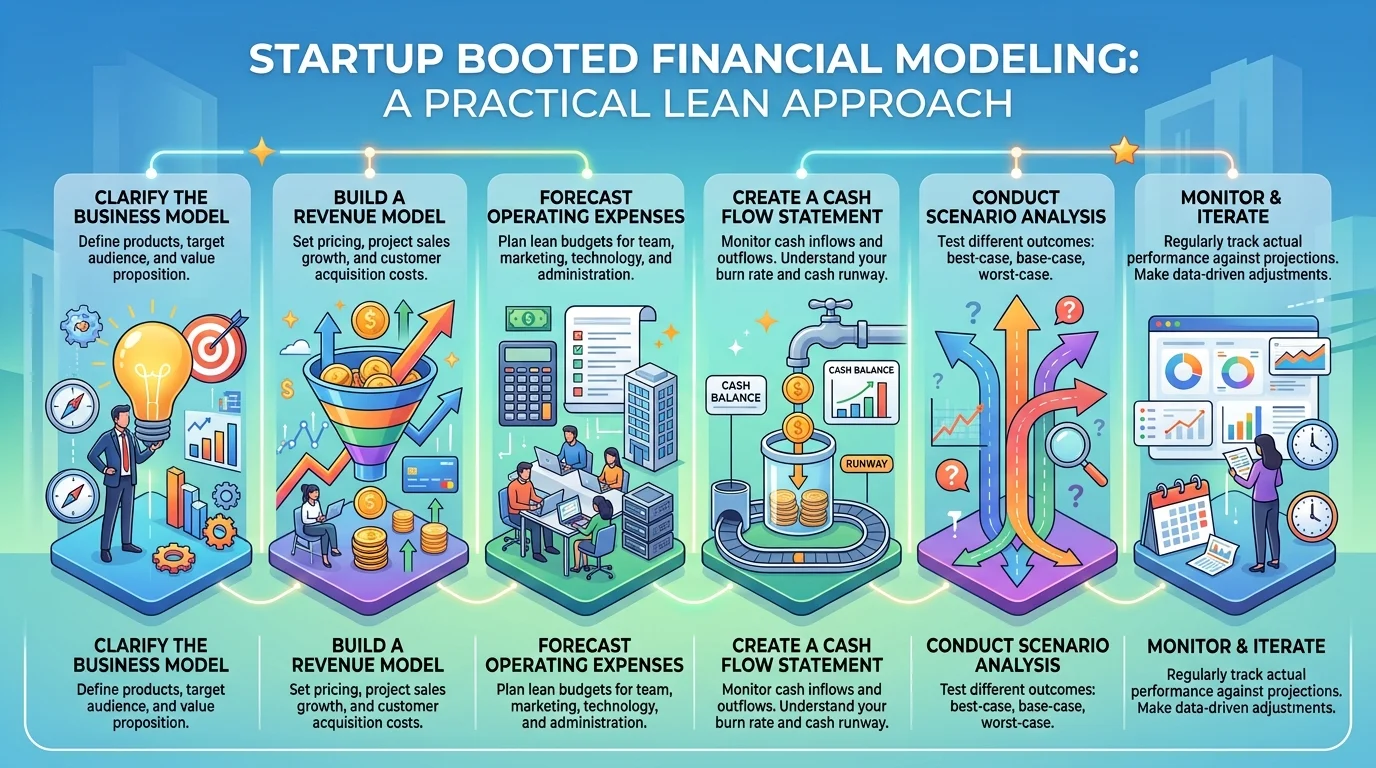
Set the structure. Build a three-statement model linking the income statement, balance sheet and cash flow statement into one connected file (Corporate Finance Institute). Disconnected files produce contradictions: a profit and loss showing breakeven in month 14 while the cash forecast runs dry in month 9, with both looking correct in isolation (Fiscallion).
Separate assumptions from calculations. One tab holds every driver. No hard-coded numbers inside formulas.
Build revenue from drivers, not growth rates. Forecast on sales volumes, price points and headcount rather than a blanket percentage (Mercur). "15% monthly growth" is an output, not an input.
Model the headcount plan explicitly. Salaries are usually the largest line and the least reversible decision in the file.
Add collection and payment timing. Enter the days between invoice and cash receipt, and the same for payables. This is where growing companies discover they are cash negative.
Set the horizon and cadence. Use 12 to 18 months for operational planning and 36 months for strategic planning. Monthly detail for the first 12 months, quarterly for months 13 to 36 (CFO Pro Analytics).
Build three scenarios. Base, downside at roughly 60% of base revenue, and upside. Add a 20% buffer to net burn projections to absorb a slow month or a late payment (Forecastr).
Run variance analysis monthly. Compare forecast to actuals and update the driver, not the output. If churn was modelled at 15% and came in at 8% for three consecutive months, change the assumption (CFO Pro Analytics).
Refresh the cadence. Update the operational forecast monthly and the strategic projection quarterly so the file stays a decision tool rather than a static annual budget.
Suggested visual: a screenshot of the assumptions tab showing driver inputs separated from calculation cells.
What the bootstrapping statistics actually say
Treat published bootstrapping survival statistics with caution before repeating them. Most datasets claiming that bootstrapped companies outperform venture-backed ones are built on government registration data from the Census Business Dynamics Statistics, the Bureau of Labor Statistics and the IRS, which classify any newly formed employer firm as a startup (Paul O'Brien).
Under that definition, a landscaping company, a marketing consultancy and a bakery all count as bootstrapped Startups. Those businesses operate known, repeatable models and survive at higher rates because they are running a lower-variance business, not because bootstrapping is a superior strategy.
The defensible version of the claim is narrower. Bootstrapping removes dilution, removes dependence on a funding market the founder does not control, and forces unit economics discipline earlier. It does not make a company more likely to succeed at scale, and a model built on the assumption that it does will be wrong about growth capacity.
Common mistakes in bootstrapped financial models
Excluding founder compensation from burn. Produces a runway figure that is optimistic by exactly the amount the founders are underpaying themselves.
Forecasting revenue with a flat growth percentage. Hides which lever actually drives the number and makes the model impossible to correct when it misses.
Modelling profit instead of cash. Revenue recognised in March that gets collected in June will not pay April payroll.
Computing LTV on revenue rather than gross margin. Inflates LTV:CAC and justifies acquisition spend the business cannot fund.
Running the default alive test on planned growth. The test only works against the trailing rate the company is actually on.
Building a single scenario. One line with no downside case gives no decision threshold for cutting spend.
Setting the model up once and leaving it. A forecast that is not reconciled against actuals monthly stops describing the business within a quarter.
Frequently Asked Questions
What is startup booted financial modeling?
Startup booted financial modeling is the process of forecasting revenue, expenses, cash flow, burn rate, runway and profitability for a company funded primarily by its own income rather than outside investment. The term is a variant spelling of bootstrapped financial modeling. It helps founders make hiring, pricing and spending decisions before cash problems appear rather than after.
Is startup booted the same as bootstrapped?
Yes. "Booted" is a shortened and frequently misspelled form of "bootstrapped," and both describe a company funded by founder savings and trading revenue instead of venture capital or angel investment. Search engines resolve the two phrases to the same concept, so content covering one should reference the other.
How much runway should a bootstrapped startup have?
Bootstrapped companies should target enough cash to cover at least six to twelve months of net burn, with more if revenue is seasonal or customers pay slowly. Venture-backed companies typically target 18 to 24 months after a round, and a bootstrapped company without that funding cushion should treat dropping below six months as a trigger to cut costs or accelerate collections.
What is the difference between gross burn and net burn?
Gross burn is the total cash a company spends each month, ignoring revenue entirely. Net burn is gross burn minus monthly revenue, which is the actual amount of cash lost. Always divide cash on hand by net burn to calculate runway. Gross burn is the more useful number when modelling a worst-case scenario where revenue stops.
Should founder salaries be included in burn rate?
Yes. Every cash outflow belongs in gross burn, including founder salaries, benefits, payroll taxes and stipends. Excluding them produces a falsely optimistic runway and creates a hidden liability, because founders paying themselves below market are subsidising the company with personal cash that will eventually need replacing.
What is a good LTV:CAC ratio for a bootstrapped startup?
The widely cited minimum is 3:1, with top-quartile SaaS companies operating between 4:1 and 6:1. Only 44% of SaaS companies actually reach 3:1. For a bootstrapped company, CAC payback period is the more urgent metric, because a strong ratio with a 24-month payback still requires working capital the business may not have.
Conclusion
Startup booted financial modeling forecasts cash flow, burn rate and runway on the assumption that no outside funding arrives, which makes it an operating tool rather than a fundraising document. Build the three statements as one linked file, forecast from drivers rather than growth percentages, use net burn for runway, weight CAC payback ahead of LTV:CAC, and reconcile against actuals every month. Those five habits turn a spreadsheet into a decision system that flags a problem while it is still fixable.
If you are running a bootstrapped product and distribution is the constraint rather than the model, AIToolSync helps founders get discovered without a paid media budget. Start with the guide to AI tool directories for marketers and founders, then submit your tool to get listed.
Found this helpful? Share it with others who might benefit from these insights!
Submit Your AI Tool