Most articles about what is a startup give you one tidy sentence and call it a day. That's not enough. I've gone through the primary sources — Steve Blank, Paul Graham, Eric Ries, and the actual government notifications — and they don't agree with each other. That disagreement is the interesting part.
So here's my promise: by the end of this piece, you'll know exactly which definition applies to you, when your company stops being a startup, and why the failure statistic everyone quotes at you is wrong.
Ready? Let's get into it.
The Short Answer: What Is a Startup?
Before I unpack the nuance, you deserve a clean answer. A startup is a young company built to search for a repeatable business model that can scale rapidly under conditions of high uncertainty. It isn't defined by age, industry, or funding. It's defined by intent — the intent to grow fast and serve a large market rather than a local one. That's the encyclopedic startup definition. Now let's find out why smart people still argue about it.
The Four Definitions That Actually Matter
Honestly? I wish there were just one. There isn't. Four framings dominate the literature, and each one solves a different problem for you. Read all four before you decide which label fits your early-stage company, because picking the wrong one leads founders to raise money they don't need or skip validation they desperately do.
1. The search definition (Steve Blank). Blank calls a startup a temporary organization formed to search for a scalable business model. The word temporary is doing heavy lifting there. His companion idea: an established company is a permanent organization built to execute a proven model. Search versus execute. That's the whole distinction, and the Kauffman Foundation endorses it.
2. The uncertainty definition (Eric Ries). In The Lean Startup, Ries describes a human institution designed to deliver a new product or service under conditions of extreme uncertainty. Notice what's missing — no mention of tech, no mention of money.
3. The growth definition (Paul Graham). Graham's essay "Startup = Growth" is the most aggressive of the three. A startup is a company designed to grow fast. Being newly founded doesn't make you one. Neither does working on technology or taking venture capital. Growth is the only essential trait.
4. The regulatory definition. Governments need something they can audit. India's DPIIT framework, updated by Gazette Notification G.S.R. 108(E) in February 2026, defines a startup by age (under 10 years), turnover (under ₹200 crore), entity type, and innovation. Deep tech ventures get 20 years and ₹300 crore.
Which one is right? All of them. They're answering different questions.
Startup vs Small Business: The Difference Nobody Explains Well
You've probably seen the comparison table version of this a dozen times. Growth versus stability, national versus local, blah blah. Fine, but shallow. The real difference in the startup vs small business debate is structural, and once you see it you can't unsee it. A small business owner knows their model on day one — a bakery sells bread. A founder doesn't. The founder is running experiments to discover the model. That single distinction explains almost every other difference in behavior, funding, and risk.
Here's the practical version:
Startup | Small Business | |
|---|---|---|
Business model | Being searched for | Known from day one |
Growth intent | Fast, non-linear | Steady, sustainable |
Market | National or global | Local or niche |
Funding | Often equity, sometimes bootstrapped | Loans, revenue, savings |
Success measure | Scale and exit strategy | Profitability |
And look — a lifestyle business isn't a lesser thing. It's just a different vehicle. Plenty of founders would be happier running one.
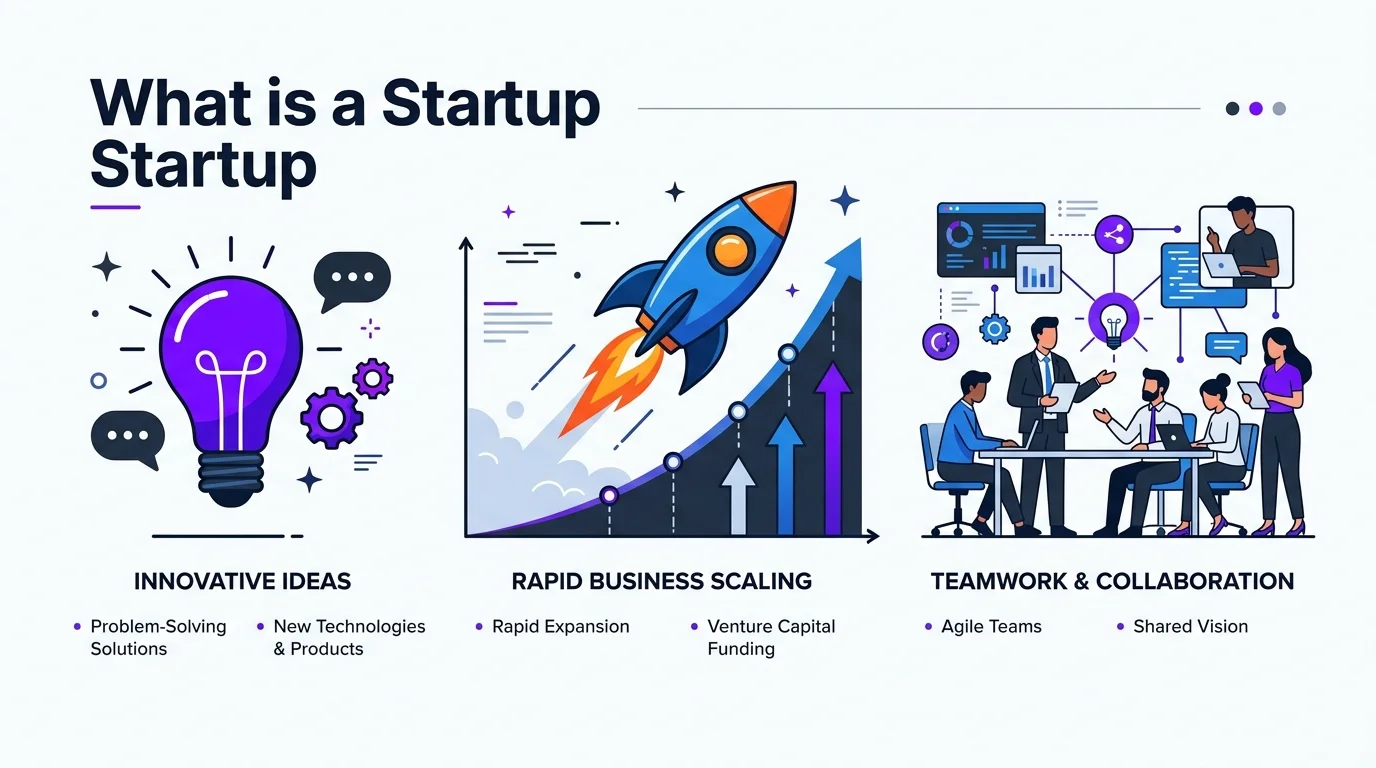
What Makes a Company a Startup? Three Traits
I get asked this constantly, usually by people who've registered a company and want to know if the label fits. The honest test isn't your logo or your pitch deck. It comes down to three things: whether your economics scale, whether you're operating under genuine uncertainty, and whether you actually intend to grow beyond your neighborhood. Miss any one of them and you're something else. That's not an insult.
Scalability. Can you serve ten thousand customers without ten thousand times the cost? StartupBlink uses this as a core screening criterion — software scales, a barbershop doesn't.
Uncertainty. You're testing hypotheses about customers, pricing, and channels. If you already know the answers, you're executing, not searching.
Growth intent. Design matters more than current size. Graham's point stands: a two-person company aiming at a global market is a startup; a fifty-person company serving one city may not be.
The Startup Lifecycle: A Step-by-Step Guide
Alright, this is the part you can actually act on. The path from idea to scale isn't mystical, though founders love to make it sound that way. It's a sequence of evidence-gathering steps, and each one exists to kill a specific assumption before it kills you. Follow these five in order. Skipping ahead is the single most common way founders waste two years and a lot of somebody else's money.
Step 1 — Validate the problem. Talk to potential customers before you build. This is Blank's customer discovery. Aim for painful, frequent, expensive problems.
Step 2 — Build an MVP. A minimum viable product is the smallest thing that tests your riskiest assumption. The University of Queensland's explainer frames it well — just enough features to be usable by early adopters.
Step 3 — Run the build-measure-learn loop. Ship, measure real behavior, learn. Then decide: pivot or persevere. Validated learning is your unit of progress here, not lines of code.
Step 4 — Reach product-market fit. You'll know because demand starts pulling you. Product-market fit means the repeatable, scalable model exists and you've proven it.
Step 5 — Scale, then exit or endure. Now you execute. Raise growth capital, expand channels, build the team. Our guide to the tools that support each stage of startup growth walks through what to adopt and when.
Startup Funding Stages, Explained
Funding terminology intimidates first-time founders more than it should. Each round exists to buy you the evidence required for the next one. Understanding the startup funding stages saves you from the classic mistake of pitching a Series A funding partner with a pre-seed story. Here are the 2026 reference ranges, per Startups.com's funding lexicon.
Pre-seed round: roughly $250K–$1M, usually on a SAFE agreement. Investors are angel investors and accelerators.
Seed funding: $2.5M–$4M median. You need an MVP and early traction.
Series A: $10M–$15M. Proven product-market fit and revenue required.
Series B and beyond: $20M–$40M+. You're scaling a model that already works.
One number worth internalizing: the median gap between seed and Series A has stretched to about 20 months. Plan your runway accordingly. Not raising at all? That's a legitimate path, and our breakdown of bootstrapped startup fundraising strategy covers how founders fund growth without giving up equity.
Now for the context nobody gives you. Crunchbase reported a record $510 billion in global venture funding in the first half of 2026 — more than all of 2025. Sounds like an easy market, right? It isn't. OpenAI and Anthropic alone absorbed more than 40% of that total, and over 70% of Q2 capital went to AI-focused companies. Meanwhile 195 new unicorns joined the Crunchbase board in the same six months. Record totals, extremely concentrated distribution. Read the headline carefully before you assume capital is falling from the sky.
Why Most Startups Fail (And Why the Stat You've Heard Is Wrong)
Here's the correction I most want you to take away. You've been told 42% of startups fail because there's no market need. That figure comes from CB Insights' original post-mortem sample popularised around 2014, and it has been superseded. Their newer study of 431 failed venture-backed companies — roughly four times the sample — separates root causes from symptoms, and the numbers change meaningfully once you do that.
Poor product-market fit: 43% — the actual root cause.
Ran out of capital: 70% — but this is the final symptom, not the disease. Those 431 companies had raised $17.5 billion between them.
Bad timing or macro conditions: 29%
Unsustainable unit economics: 19%
The "90% of startups fail" line needs the same scrutiny. It applies to innovative, venture-scale startups. Failory's analysis is useful here. For all new US businesses, Bureau of Labor Statistics data puts first-year failure at 20.4%, rising to 49.4% by year five. Two completely different populations, quoted interchangeably by people who should know better.
The lesson? Money doesn't save you. Evidence does. And if cash flow is where you feel exposed, our walkthrough of financial modeling for early-stage startups is the right next read.
When Does a Startup Stop Being a Startup?
Almost nobody answers this, which is odd because it's one of the most searched follow-ups. Blank's framing gives you the cleanest exit criteria available: the moment you stop searching and start executing a validated model, you've graduated. The label falls away quietly. Regulatory definitions are stricter — under India's framework, you cease to be recognized at ten years or once turnover crosses the threshold, whichever hits first.
Other common markers? Profitability. A large funding round. Acquisition or IPO. TechTarget notes there are no firm rules here, so pick the definition that serves your decision.
Three Examples That Clarify Everything
Definitions get abstract fast. Examples fix that. Each of the three below sits in a different category, and comparing them tells you more than another paragraph of theory would.
A current startup: Anthropic. Young, searching for scale in a new category, absorbing enormous capital under real uncertainty. Textbook.
An ex-startup: Amazon. It began by selling books online and searched hard for its model. It stopped being a startup decades ago. It now executes a proven model at enormous scale.
Never a startup: your neighborhood accounting firm. Profitable, valuable, well-run, serving a local market with a known model. Not a startup, and it doesn't need to be.
Frequently Asked Questions
How long is a company considered a startup?
There's no universal rule. Blank's test is functional — you stop being a startup when you stop searching and start executing. Regulatory frameworks like India's DPIIT use a hard 10-year cap (20 years for deep tech).
Do all startups need venture capital?
No. Paul Graham explicitly states that taking venture funding is not a requirement. Many bootstrapped companies qualify on growth and scalability alone.
Can a startup be profitable?
Yes, though many aren't early on because they prioritize growth over near-term margin. Profitability is often one of the markers people use to say a company has outgrown startup status.
What percentage of startups fail?
Roughly 90% of innovative, venture-scale startups fail over their lifetime. For all new US businesses, BLS data shows 20.4% fail in year one and 49.4% within five years.
What's the difference between a startup and an entrepreneur?
A startup is the organization. An entrepreneur is the person building it. Entrepreneurship covers all new ventures, including small businesses that will never be startups.
Does a startup have to be a tech company?
No. Technology is common because it scales cheaply, but the defining traits are scalability, uncertainty, and growth intent — not the industry.
What is product-market fit?
The point at which you've proven a repeatable, scalable model that genuinely drives demand. It's the milestone that separates the search phase from the scaling phase.
What are the main startup funding stages?
Pre-seed, seed, Series A, Series B, and later growth rounds, typically ending in an acquisition or IPO.
Where to Go From Here
So — what is a startup? It's a company searching for something it hasn't found yet. That's the honest version, and it's more useful than any tidy one-liner because it tells you what to do next: run the experiment, gather the evidence, and stop guessing.
If you're at the validation stage, start with Step 1 above. Talk to twenty potential customers this month before you write a line of code. If you're already past product-market fit, your job has changed — you're executing now, and distribution becomes the constraint.
That's where AIToolSync fits in. If you've built an AI product, getting it in front of people actively searching for a solution like yours is the cheapest growth channel available to an early-stage team. Submit your tool to AIToolSync and you'll get a dedicated profile page, a do-follow backlink, and visibility with founders and marketers already looking. Free submissions are reviewed within 48–72 hours.
Found this helpful? Share it with others who might benefit from these insights!
Submit Your AI Tool