
Yes, you can get a startup business cards with no business credit history — you just need to pick the right type. Traditional cards check your personal credit, corporate cards check your revenue and cash flow, and secured cards just need a refundable deposit. Below, I'll walk you through all three paths, plus the exact steps to build real business credit starting today.
So you're starting a business and you've hit that wall, right? You want a business credit card, but you've got zero business credit history. Maybe your personal credit isn't perfect either. I get it — this is one of the most common roadblocks new founders run into, and honestly, it trips up way more people than it should.
Here's the good news, though. You don't need years of credit history to get approved for a card that actually works for your startup. And if you're also figuring out how to fund the business itself, it's worth reading up on bootstrapped startup fundraising strategy alongside this guide — the two go hand in hand. Let's dig in.
What Does "No Credit" Actually Mean Here?
This trips people up constantly, so let's clear it up first.
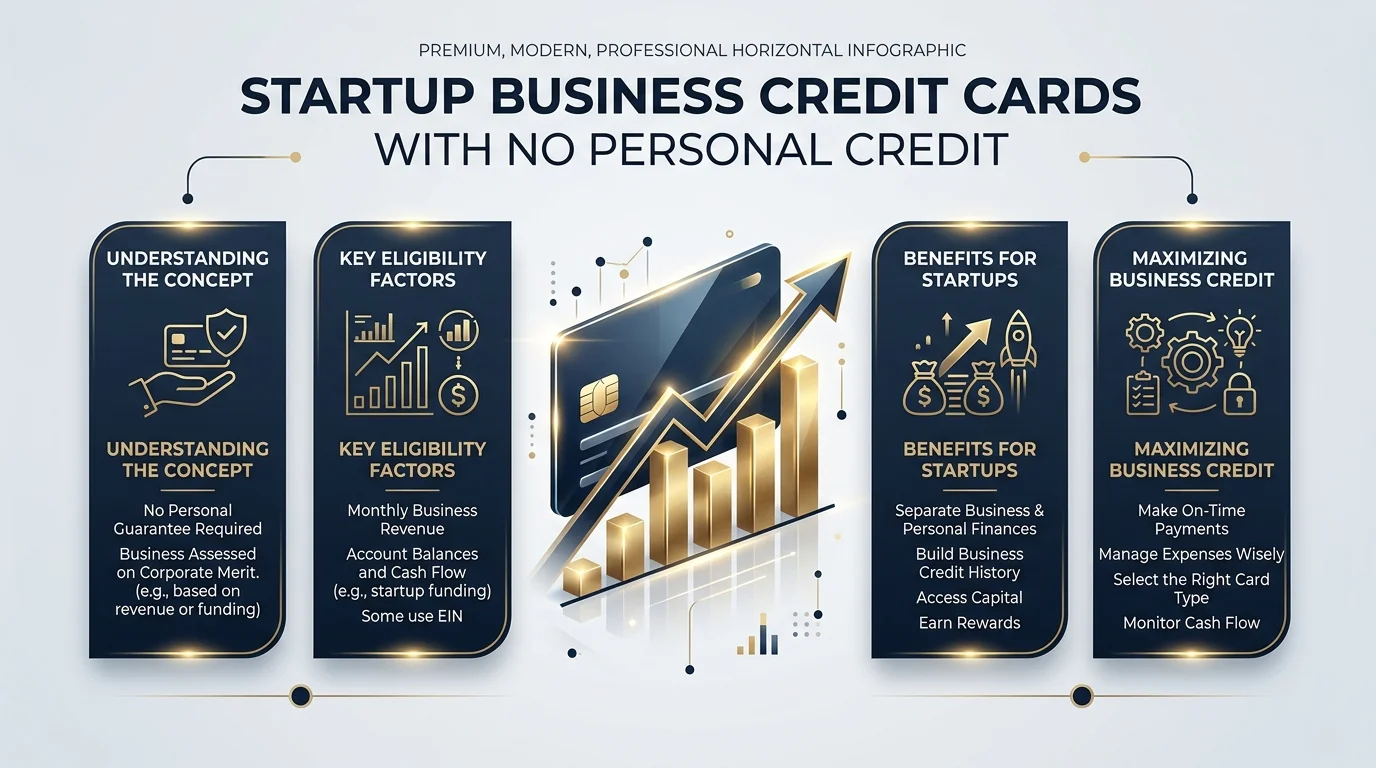
When you see a card marketed as having no credit check business credit card options, that phrase is a little misleading. In most cases, it means the issuer isn't checking your business credit — not that they're skipping evaluation altogether. Your business is brand new, so of course it doesn't have a credit file yet. That's expected.
What issuers do instead depends on the card type:
Some still peek at your personal credit score
Others look at your business's cash flow or revenue
Some just ask for a refundable deposit
Here's a stat that might surprise you: over 50% of employer firms use credit cards just to fund day-to-day operations, according to Federal Reserve data referenced by Nav. You're really not alone in needing this.
Quick definitions: PAYDEX Score — a 1–100 rating from Dun & Bradstreet measuring how reliably your business pays its bills. 80+ is considered low risk. D-U-N-S Number — a free, unique 9-digit identifier from Dun & Bradstreet used to track your business's payment history. No D-U-N-S number, no PAYDEX score.
The Three Paths to Approval (Pick Your Lane)
Okay, so how do you actually get approved with no history? There are basically three routes, and each one fits a different type of founder.
1. Traditional Business Credit Cards
These are your classic bank-issued cards — think Chase, Capital One, that world.
Truthfully? These usually require a personal guarantee and a personal credit check. So if your personal FICO score is solid, this path might be the easiest for you. The Capital One Spark Classic is a great example — it's built for founders with fair or limited credit, and it doesn't need an established business score to qualify.
2. Corporate & Fintech Cards
This is where things get interesting.
Cards from companies like Brex, Ramp, and Mercury flip the script entirely. Instead of checking your personal credit, they evaluate your cash flow, bank balance, or revenue. No personal guarantee needed in a lot of cases.
The catch? These cards often want to see real funding or consistent revenue, which can be tough if you're still pre-revenue. Still — if you've raised a seed round or you've got healthy cash in the bank, this route can get you way higher limits than a traditional card ever would.
3. Secured Business Credit Cards
Honestly, this is probably your fastest path if you're starting from absolute zero.
A secured business credit card asks you to put down a refundable deposit, and that deposit becomes your credit limit. Simple. OpenSky's Secured Visa is a standout here — no credit check, no bank account requirement, and deposits range from $200 to $3,000. It reports to all three major bureaus too, which matters a lot for building your file.
Quick Comparison
Card | Credit Check | Deposit/Requirement | Best For |
|---|---|---|---|
Capital One Spark Classic | Personal credit check | None (fair/limited credit ok) | Founders with decent personal credit |
Chase Ink Business Unlimited | Personal credit check | Strong personal credit needed | Established founders, larger purchases |
Brex / Ramp | No personal check | Revenue or cash balance | Funded startups with real revenue |
Mercury IO Credit | No personal check | No minimum balance | Early-stage, low cash founders |
OpenSky Secured Visa | No credit check | $200–$3,000 deposit | Starting from zero, building credit fast |
Step-by-Step: How to Actually Get Approved
Let's make this practical. Here's exactly what you should do, in order.
Step 1: Set Up Your Business Entity
You can't build business credit as a sole proprietor running under your own name — there's nothing for the bureaus to attach a file to. Form an LLC or corporation first. It's the foundation everything else sits on.
Step 2: Get Your EIN
This is free, takes about fifteen minutes on the IRS site, and it's non-negotiable. Your EIN becomes your business's identity for credit purposes — kind of like your SSN, but for your company.
Step 3: Open a Business Bank Account
Don't skip this. Mixing personal and business finances is a mess come tax season, and it also keeps your spending out of your personal credit report. If you're still mapping out your finances at this stage, our guide on startup financial modeling is a good companion read for getting your numbers straight before you apply.
Step 4: Apply for a D-U-N-S Number
This one's huge and people skip it constantly. Your D-U-N-S number is how Dun & Bradstreet tracks your payment history. Without it, there's literally nothing to report your PAYDEX score against. It's free — just be patient with the timeline.
Step 5: Pick Your Card Based on Your Profile
Strong personal credit? Go traditional. Solid revenue or cash on hand? Go corporate. Starting from scratch? Go secured.
Step 6: Open a Few Vendor Tradelines Too
Even while you're using your new card, open net-30 accounts with vendors like Uline, Grainger, or Quill. They report to D&B, and you need at least three active tradelines before a PAYDEX score even generates.
Why Paying Early Matters More Than You'd Think
Here's something most people don't realize: paying on time only gets you an 80 on your PAYDEX score. That's the floor, not the ceiling.
Paying early is what pushes you into the 90–100 range — and that gap isn't just cosmetic. It genuinely affects how lenders and vendors perceive your business's reliability. So if you want your business credit score to actually mean something, build the habit of paying ahead of schedule from day one.
Frequently Asked Questions
Can I get a business credit card with just an EIN?
Yes. Some corporate cards, like Slash's Visa Platinum, only require an EIN and skip the personal guarantee entirely, basing your spending power on your business's actual financial performance instead.
How long does it take to build a PAYDEX score?
Typically, you'll see a single reporting tradeline within 30–90 days, a usable PAYDEX score in 3–6 months, and a mature, well-established credit file in 12–24 months — assuming consistent on-time (or early) payments.
Does a secured business credit card hurt my credit?
No — a secured card is actually one of the best ways to build credit safely, since your deposit limits your risk and the issuer's risk simultaneously. Just make sure the card reports to the business credit bureaus.
What's the difference between business credit and personal credit?
They're completely separate files at separate bureaus. Personal credit (FICO/VantageScore) is tied to your SSN and reported by Equifax, Experian, and TransUnion. Business credit (PAYDEX, Intelliscore Plus) is tied to your EIN and reported by Dun & Bradstreet, Experian Business, and Equifax Small Business.
Do I need good personal credit to qualify for a startup business card?
Not always. Traditional bank cards usually do check personal credit, but corporate/fintech cards (like Brex, Ramp, or Mercury) and secured cards (like OpenSky) typically don't — they focus on revenue, cash balance, or a deposit instead.
Should You Actually Get One of These Cards?
Look, I'll be straight with you — if you're running a business, you need a way to separate expenses, track spending, and start building a credit file that isn't tied to your Social Security number forever. A startup business credit card does all three.
It's not just about convenience either. Every month you wait to start building business credit is a month you're delaying access to better financing later — bigger limits, lower rates, real leverage when you need to scale. Starting now, even with a small secured card, puts that clock in motion.
So don't overthink this. Pick the lane that fits your current profile from the table above, follow the six steps, and get moving. Your future self — the one applying for a $50,000 line of credit in eighteen months — will thank you.
Found this helpful? Share it with others who might benefit from these insights!
Submit Your AI Tool