
Short answer: Pick ChatGPT if you write for clients, need enterprise governance, or want the deepest tool ecosystem. Pick Grok if you live on X, run high-volume API workloads where cost compounds, or code heavily in Cursor. If you can spend $50/month, run both — that's what I do.
Key Takeaways
Grok 4.5 (July 8, 2026) and GPT-5.6 (July 9, 2026) are the current models — most comparisons online still test versions two generations old.
Grok is roughly 60% cheaper per token on the API; ChatGPT Plus is cheaper on subscription.
Grok owns real-time X data; ChatGPT owns writing consistency and enterprise adoption.
Cross-vendor benchmark scores are rarely comparable — versions and methodologies differ.
xAI is now owned by SpaceX, which introduces a procurement risk most reviews skip.
Now here's my honest take on the grok vs chatgpt comparison 2026 question: almost every article you've read on it is out of date. Not slightly. Badly. Most still stack Grok 3 against GPT-5.5 like it's February. I've spent weeks testing both, pulling benchmark data, and reading filings — and the picture in late July 2026 looks nothing like those posts describe.
Let's dig in.
Grok vs ChatGPT Comparison 2026: The Spec Table
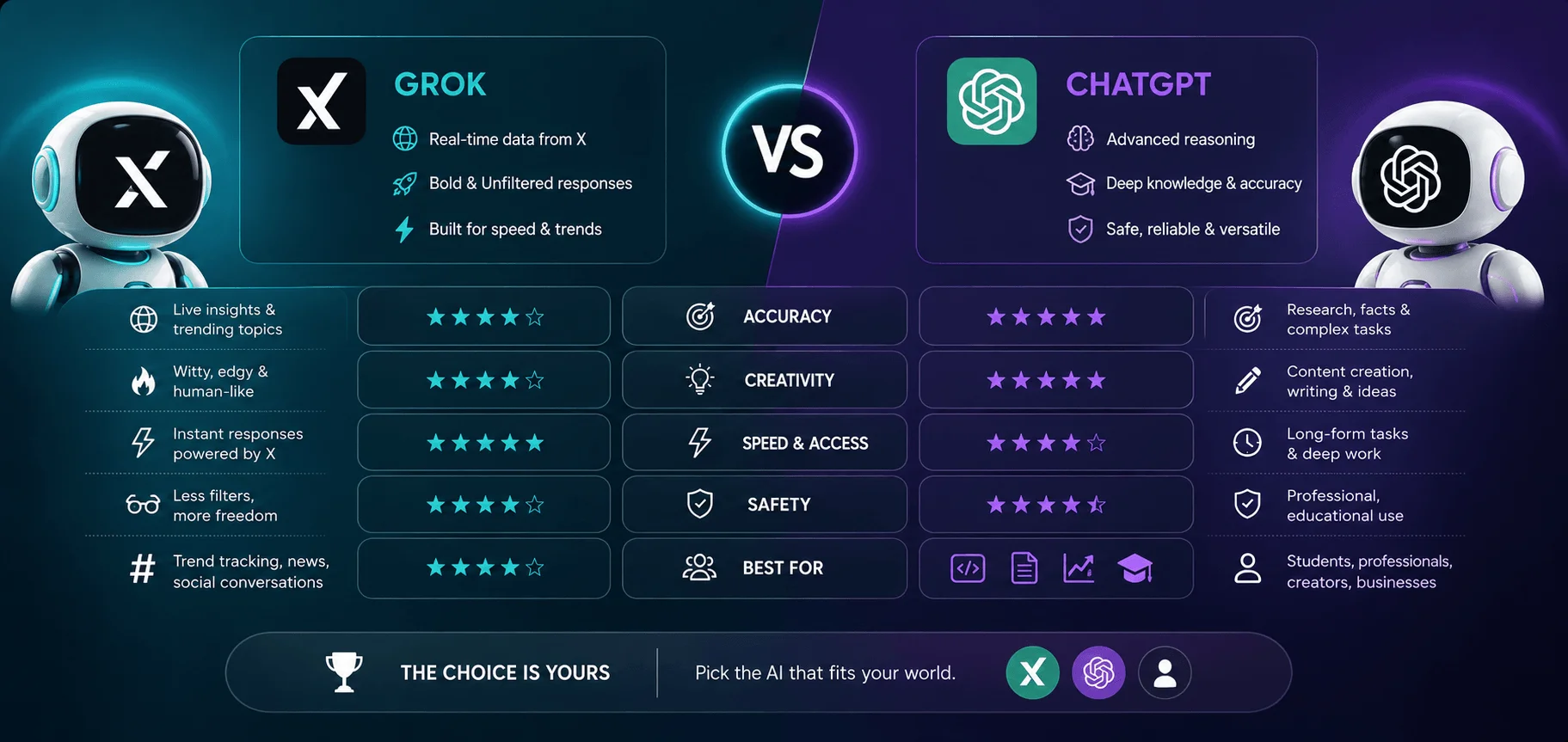
Here's the whole thing on one screen. I've limited this to figures traceable to a primary source or an independent evaluator — no blog-to-blog telephone. You'll notice I've deliberately kept benchmark scores out of this table and given them their own section below, because cross-vendor benchmark comparison is where most articles quietly mislead you. Everything here was checked against live documentation on July 29, 2026.
Grok 4.5 (xAI/SpaceXAI) | GPT-5.6 Sol (OpenAI) | |
|---|---|---|
Released | July 8, 2026 | July 9, 2026 (GA) |
API price /1M tokens | $2 in / $6 out | $5 in / $30 out |
Consumer plan | SuperGrok ~$30/mo | ChatGPT Plus $20/mo |
Context window | 1M tokens | ~1.05M tokens |
Real-time data | Native X firehose | Web browsing |
Architecture | Mixture of experts, 1.5T params | Omnimodal, retrained base |
Avg. session length | 11m 20s | 5m 54s |
Enterprise footprint | Small | ~92% Fortune 500 |
Best for | Cost, live data, agentic coding | Writing, ecosystem, compliance |
Two rows deserve a flag. Grok's price is less than half — but cost per token is not cost per task, and I'll show you how to calculate the difference. And that session-length gap is the most underrated stat in this comparison.
Quick Definitions Before We Go Further
Three terms come up constantly in AI model comparison writing and get used loosely. Here's what each actually means, so the rest of this article lands properly.
Agentic coding means the model plans and executes a multi-step task inside a real codebase — reading files, running commands, checking its own output — rather than producing a single code snippet on request.
Token efficiency is how many tokens a model burns to complete a given task. A model can cost more per token and still be cheaper overall if it finishes in fewer steps.
Context window is the total text a model holds in working memory at once, measured in tokens. Roughly 750,000 words at the 1M mark.
What Changed in the Grok vs ChatGPT Landscape
You need the current board state before comparing anything. Because if you're comparing the wrong models, every conclusion after that is wrong too. Both companies shipped twice since spring. One of them also got acquired, and that second part matters more than most reviewers admit. Here's the short version of who's fighting whom in the openai vs xai race as of this month.
On OpenAI's side, GPT-5.5 launched April 23, 2026 with a 1 million token context window. Solid release. Then it got replaced.
The GPT-5.6 family hit general availability July 9, 2026, splitting into three tiers — Sol, Terra, and Luna. Sol runs $5/$30, Terra $2.50/$15, and Luna $1/$6 per million tokens (rates as of July 28, 2026).
xAI moved faster. Grok 4.3 arrived on the API April 30 with native video input. Then SpaceXAI released Grok 4.5 on July 8 — Musk called it "an Opus-class model, but faster, more token-efficient and lower cost."
And here's what nobody's telling you: xAI isn't a scrappy startup anymore. SpaceX acquired it in February 2026.
Why the Version You're Comparing Matters So Much
I want to slow down here, because this is where readers get burned. You read a comparison, it says "Grok scores 72% on HumanEval," you make a purchase decision — and the number is two generations old. Release cycles have compressed to roughly six weeks. A grok vs chatgpt post from March is functionally fiction by July. So my first piece of advice isn't about either tool. It's about your reading habit.
Check the model version in any comparison before trusting it.
If it doesn't name Grok 4.5 and GPT-5.6, close the tab. Seriously. Same goes for anything citing MMLU as a primary differentiator — that benchmark saturated over a year ago.
The Head-to-Head Breakdown
Now let's get into the details that'll actually affect your day-to-day. I'm splitting this into the areas that genuinely change which tool you open: real-time data access, coding, benchmarks, writing quality, and pricing. I've ordered them by how much daylight sits between the two. Some categories are a blowout. Others are far closer than the marketing on either side would have you believe.
Real-Time Data: Grok Wins, and It Isn't Close
This is Grok's moat, and it's a real one. Grok has direct pipeline access to X — every post, trend, and reply, updating continuously, surfaced through DeepSearch. ChatGPT browses the web, which is good, but browsing and living inside a firehose are different experiences. I tested both during a product launch last month. ChatGPT gave me a tidy summary of published coverage. Grok told me what people were saying forty minutes ago, including complaints nobody had written up yet.
If your work touches breaking news, sentiment analysis, or crisis monitoring, that gap is your entire decision.
For everyone else? Nice-to-have.
Coding: The Fight Got Genuinely Interesting
For two years this was ChatGPT's by default. Not anymore. Grok 4.5 was co-developed with Cursor and trained on trillions of real developer session tokens, and xAI positioned it explicitly at agentic coding rather than chat.
xAI stopped competing on personality and started competing on engineering work.
That said, ChatGPT owns the developer ecosystem — Codex, integrations, documentation, Stack Overflow answers. Raw capability is one thing. Finding help at 2am is another. Our AI benchmarks explained guide unpacks the methodology.
Benchmark Scores: Read These Carefully
Benchmarks are the most-quoted and least-understood part of any AI comparison, so I'm going to be more careful here than most articles bother to be. The core problem is that vendors publish scores on different benchmark versions at different times. Grok 4.5's coding figure comes from Terminal-Bench 2.1; OpenAI's most recent published figure was on version 2.0, for GPT-5.5. Those two numbers are close, but they are not a head-to-head result, and anyone presenting them as one is misleading you.
Here's what can be said cleanly:
On Artificial Analysis, Grok 4.5 ranks fourth on the Intelligence Index, above every Gemini and open-weight model, at over 60% lower cost than Opus 4.8 or GPT-5.5.
Grok 4.5 uses roughly 14,000 output tokens per Intelligence Index task versus 67,020 for Opus 4.8 — a token-efficiency gap that matters more than raw score for most budgets.
GPT-5.5 posted 82.7% on Terminal-Bench 2.0 and 58.6% on SWE-Bench Pro, the strongest agentic-coding results OpenAI had shipped at that point.
Independent evaluator Vals AI placed Grok 4.3 #1 on CaseLaw v2 at 79.3% accuracy — a 25-point jump in legal reasoning over its predecessor.
So which is the "better" model?
Wrong question. The right one is: better at what, measured by whom, on which version.
One more caveat — AI hallucination rate varies enormously by task type on both, and neither vendor publishes it prominently. LMSYS Chatbot Arena measures human preference, not accuracy. Don't conflate them. Verify current figures at LLM Stats or OpenRouter before you cite anything, including me. And if you're weighing more than two options, our ChatGPT vs Claude vs Gemini comparison covers how the wider field stacks up.
Writing Quality: ChatGPT, Comfortably
I'll be blunt, since you came for a straight answer. ChatGPT produces cleaner long-form content. More consistent across a 2,000-word draft, better at holding structure, far less likely to swerve into a tonal detour halfway through. Grok writes with more personality — genuinely funnier — but personality is a liability in client deliverables. One hands-on test had Grok winning 46–34 across 28 tests, yet ChatGPT took Writing and User Experience outright.
Use Grok to brainstorm. Use ChatGPT to ship.
On AI image generation, Grok's policies are looser and its output faster. ChatGPT's is more consistent and safer for commercial use.
Pricing: Where the Math Gets Confusing
Here's the section I wish someone had written before I started paying for both. ChatGPT pricing and Grok pricing look simple on the surface and are anything but underneath. Subscription tiers, API tiers, token efficiency multipliers, and a routing behavior that quietly changes what you receive. If you're spending real money — especially through the API — this section will save you more than the subscription costs.
Free tier limits: Both offer free access. ChatGPT Free gives limited GPT-5 access with unlimited mini. Grok's free tier is usable but message-capped.
On paper, Grok is dramatically cheaper. On paper.
The Cost-Per-Token Trap: A 5-Step Calculation
Token price isn't what you pay. Cost per completed task is what you pay, and the two often point in opposite directions. A model costing half as much per token but burning three times the tokens is more expensive, full stop.
Here's how to work out your real AI API cost:
Pick three real tasks from your week — not toy prompts. An actual refactor, research brief, and draft.
Run each on both models through the API, not the chat app, so you get token metadata back.
Record total input and output tokens per completed task, including retries. Retries count. They're the hidden cost.
Multiply by list price, then subtract your prompt caching discount — cached input runs a fraction of standard rates on both platforms.
Divide by quality. If one model needed two attempts and the other needed one, that's your real answer.
Most teams jump straight to step four using estimated tokens. That's why their forecasts are always wrong.
The ChatGPT Routing Issue Nobody Mentions
This one genuinely annoyed me. Since July 9, ChatGPT's Auto mode selects your underlying variant automatically — your $20 Plus query might be answered by Sol, Terra, Luna, or an older GPT-5.5 variant. You can only see which by opening a Configure setting most people never touch.
Price is fixed. Value per query isn't.
API users always get the model ID in response metadata. Chat users on defaults don't. If that routing behaviour is a dealbreaker, our roundup of the best ChatGPT alternatives covers what else is worth testing.
If that routing behaviour is a dealbreaker, our roundup of the best ChatGPT alternatives covers what else is worth testing.
Market Share and Momentum
Numbers get thrown around carelessly here, so let me anchor you to sourced figures. Scale and growth rate tell different stories, and you need both. One product is enormous and slowly losing share. The other is smaller and growing at a rate that's genuinely hard to sustain.
OpenAI reported 900 million weekly active users in February 2026, running ~2.5 billion daily prompts. Sensor Tower data via Reuters showed the app crossing 1 billion monthly actives in June 2026 — fastest consumer app ever to that mark. Meanwhile US app share slid from 69.1% in January 2025 to roughly 45–53%, depending on tracker (figures as of Q2 2026).
Grok's climb is the story. Reuters, citing Apptopia, put US chatbot share at 17.8% in January 2026, up from 1.9% a year earlier. SpaceX's Q1 2026 IPO filing put Grok near 117 million monthly active users in March 2026 — the strongest and least-cited figure in this whole comparison.
But my favorite stat is engagement: 11m 20s average visit versus ChatGPT's 5:54 (Similarweb data, May 2026). People don't just try Grok. They stay.
Privacy, Safety, and Procurement Risk
I'd be doing you a disservice by skipping this, and most comparisons do. AI safety guardrails on Grok are deliberately looser — that's a product decision, not an accident. It's also produced public incidents, including a 2025 episode xAI had to manually clean up. For personal use, fine. For brand voice or customer-facing deployment, that's a conversation you'll need to have with someone.
Enterprise AI adoption reflects this. Grok's workplace footprint remains small despite strong consumer numbers.
The SpaceX acquisition adds vendor concentration risk that didn't exist a year ago. On data handling, both offer enterprise tiers with training opt-outs — but read the terms yourself. Weigh it. Don't ignore it.
Frequently Asked Questions
These are the questions I get asked most, answered directly. All figures verified July 29, 2026.
Is Grok better than ChatGPT for coding?
For cost efficiency and agentic work, Grok 4.5 is now competitive — it was trained on real Cursor developer sessions and runs at roughly half GPT-5.5's per-task cost in Codex-style workloads. ChatGPT still wins on ecosystem, documentation, and integrations. Choose Grok for cost-performance; choose ChatGPT if you need mature tooling around the model.
Is Grok free to use?
Yes, with limits. Grok has a free tier accessible through X and grok.com with message caps. SuperGrok runs about $30/month and removes those caps while unlocking DeepSearch and the newest models. X Premium+ at roughly $40/month bundles Grok access with X features.
Which is cheaper, Grok or ChatGPT?
Grok, on the API: $2/$6 per million tokens versus GPT-5.6 Sol's $5/$30. But ChatGPT Plus at $20/month undercuts SuperGrok's $30 on subscriptions. For heavy API workloads Grok's advantage compounds significantly, especially given its token-efficiency profile.
Does ChatGPT have real-time data access?
ChatGPT browses the web and retrieves current information, but it lacks Grok's direct pipeline into X's live post stream. For breaking news, live sentiment, and trend monitoring, Grok is meaningfully faster and more granular. For verified, sourced current information, ChatGPT is more reliable.
Which has the bigger context window?
Effectively tied. Grok 4.5 offers 1 million tokens; GPT-5.6 Sol offers approximately 1.05 million. Both handle long documents comfortably. Watch pricing cliffs — some xAI tiers bill requests above 200,000 tokens at double rate, and OpenAI applies similar long-context surcharges.
Can Grok replace ChatGPT for business use?
For most businesses, not yet. Grok's consumer growth hasn't translated into enterprise seats, its guardrails are looser, and compliance tooling is less mature. It works well as a supplementary research and monitoring tool. ChatGPT remains the safer primary deployment for customer-facing or regulated work.
Is Grok safe to use?
For personal and internal work, yes. For public-facing brand output, be cautious — Grok's guardrails are intentionally looser and it has a documented history of moderation incidents. Review your enterprise terms and set an internal review step before anything Grok writes goes public under your name.
Which AI is more accurate, Grok or ChatGPT?
Neither is reliably more accurate across the board. Grok leads on some specialised reasoning benchmarks; ChatGPT is more consistent on general knowledge work and has more mature citation behaviour. Verify anything important from either model — hallucination rates on both remain non-trivial and are not published transparently.
Does Grok work outside of X?
Yes. Grok is available at grok.com, through standalone iOS and Android apps, via the xAI API, and inside Cursor. The X integration is the differentiator, not the requirement — you can use Grok without an X account.
Can I use both Grok and ChatGPT together?
Yes, and it's what I'd recommend if your budget allows. Roughly $50/month gets you both. Use Grok for anything time-sensitive or research-heavy, and ChatGPT for anything that needs to be structured, consistent, and client-ready. They complement each other more than they overlap.
What is the newest Grok model in 2026?
Grok 4.5, released July 8, 2026 by SpaceXAI. It's built on a 1.5-trillion-parameter mixture-of-experts foundation and positioned for coding, agents, and knowledge work rather than chat alone. xAI's developer documentation currently recommends it as the default model for code and high-intelligence use cases.
Is GPT-5.6 better than GPT-5.5?
Yes, on capability and flexibility. GPT-5.6 splits into three tiers — Sol, Terra, and Luna — letting you route requests by cost rather than paying flagship rates for everything. Sol matches GPT-5.5's $5/$30 pricing while Luna drops to $1/$6, making the family cheaper in practice for mixed workloads.
Grok vs ChatGPT Comparison 2026: My Final Verdict
If you'd asked me in 2025, I'd have said ChatGPT without pausing. Today I actually have to think — and that's the real headline of this grok vs chatgpt comparison 2026. Grok closed a gap most assumed was permanent, and it did so by getting cheaper and faster rather than edgier. ChatGPT still wins on reliability, breadth, and the boring institutional stuff that matters enormously at scale.
Found this helpful? Share it with others who might benefit from these insights!
Submit Your AI Tool