
To start digital marketing, learn the landscape, pick one channel, build a practice website, master GA4, learn keyword research plus AI search optimization, earn free certifications from Google and HubSpot, then run one real campaign. Most beginners reach a portfolio-ready level in about 90 days, at zero cost.
Here's the thing nobody tells you when you Google "how to start digital marketing."
You get a list. Learn SEO. Learn ads. Learn email. Cool. But nobody shows you the order. Nobody tells you what to skip.
I've watched hundreds of beginners stall out at week three because they tried to learn everything at once.
So this guide is different. It's the roadmap I'd hand my younger self — built for how search actually works in 2026, not 2019.
Let's get into it.
What Digital Marketing Actually Means (In Plain English)
Before you learn a single tactic, you need a clean mental model. Otherwise you'll collect random skills that don't connect. Digital marketing is simply promoting a product, service, or brand through online channels — search engines, social platforms, email, and paid ads. That's it. According to HubSpot, it covers every marketing effort that happens on the internet. The magic isn't any single channel. It's that every action is measurable, which means you can prove what works.
And that measurability? It's why budgets keep moving here.
Global digital ad spend is projected to hit roughly $835 billion in 2026 — about 68.7% of all advertising worldwide, according to industry forecasts.
Translation: the money already moved. You're not early. But you're not late either.
Why 2026 Is Genuinely a Weird (Good) Time to Start Digital Marketing
I'll be straight with you — the ground shifted under this industry, and that's your advantage. Veterans built careers on tactics that are now half-broken, which means beginners and experts are closer to level than they've been in a decade. Two things changed everything: third-party cookies died, and AI answers took over the top of the search results. If you learn the new game first, you skip the unlearning phase entirely.
Here's what I mean.
Ahrefs analyzed 300,000 keywords and found AI Overviews correlate with a 58% drop in click-through rate for the #1 organic result.
Brutal, right?
But impressions for those same pages rose about 49%. So visibility didn't die — it relocated. And EMARKETER forecasts roughly 31.3% of Americans will use generative AI search this year.
Meanwhile, first-party data and zero-party data replaced creepy tracking. Brands now have to earn audience information.
That's a skill. And you can learn it in a weekend. If you want to see how practitioners are already adapting, our breakdown of AI marketing tools that automate and scale campaigns shows what the modern stack looks like.
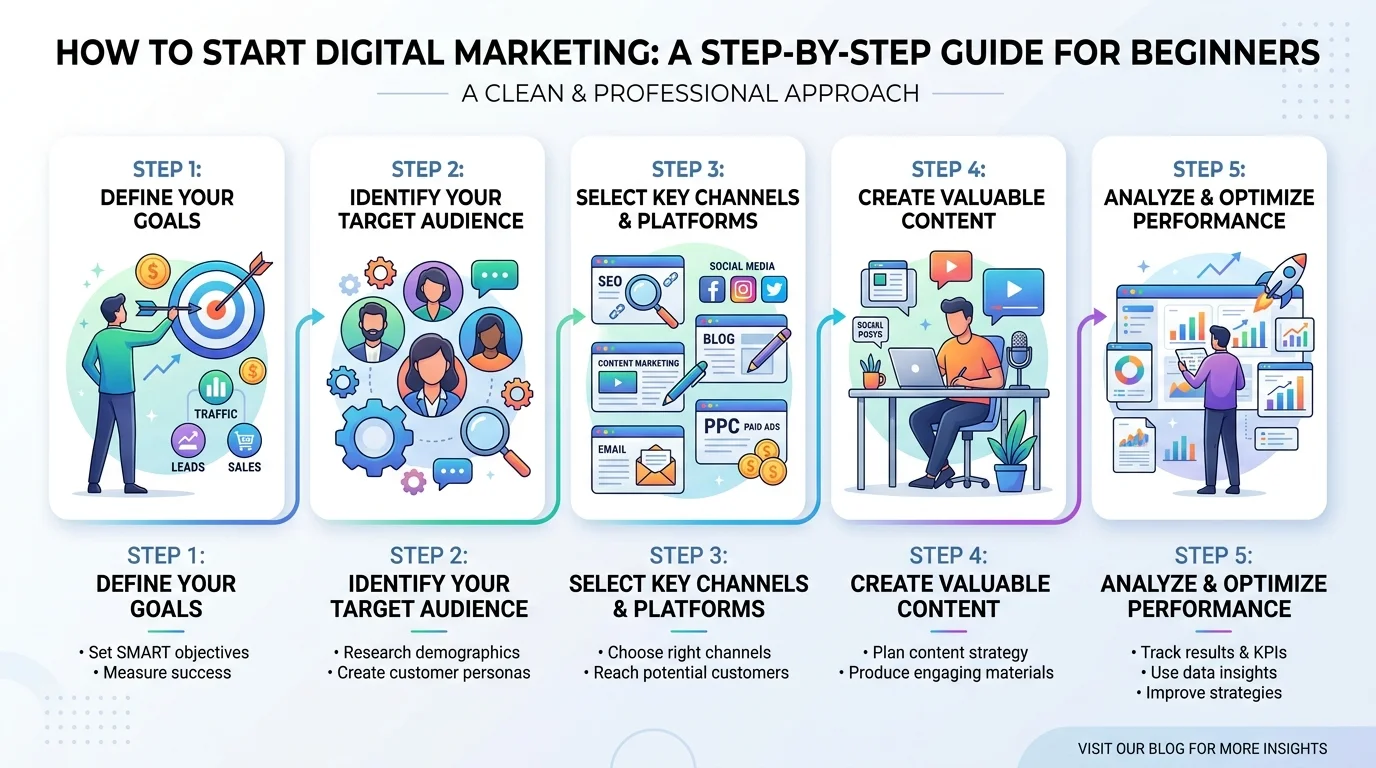
The 7-Step Roadmap I'd Follow to Start Digital Marketing From Scratch
Most beginner guides give you a menu. I'm giving you a sequence, because order matters more than effort. Each step below builds on the last, and I've deliberately front-loaded the skills that make you employable fastest. Follow it in order and you'll have a portfolio in about 90 days. Skip around and you'll be that person with eleven half-finished courses and zero results. Your call — but I'd follow the order.
Step 1: Learn the Digital Marketing Landscape (Week 1)
Spend seven days understanding how the pieces connect before touching a tool.
You want to know how SEO, content marketing, social media marketing, email marketing, and PPC advertising feed each other. HubSpot's owned, earned, and paid media framework is the cleanest mental model I've found for this.
Don't take notes forever. One week. Move on.
Step 2: Pick One Primary Marketing Channel (Week 2)
This is where most people fail. They pick zero.
Choose based on temperament:
Love writing and patience? Go SEO and content.
Love numbers and fast feedback? Go paid media — Google Ads and Meta Ads.
Love visuals and community? Go social and short-form video. If that's you, our guide on how to build a social media marketing team explains the roles you'll eventually grow into.
Pick one. Go deep. Add the others later.
Step 3: Build Your Own Practice Website (Weeks 3–4)
You cannot learn this from videos alone. Full stop.
Start a real website, blog, or social account about something you genuinely care about. Reliablesoft makes this point repeatedly — practical experience on your own web properties is the step that separates people who get hired from people who collect certificates.
Your site is your lab. Break it. Fix it. Rank it.
Step 4: Master the Analytics and Measurement Stack (Week 5)
If you can't measure it, you can't sell it.
Learn Google Analytics 4 (GA4) and Google Search Console properly. Understand click-through rate, conversion rate, cost per click, and return on ad spend (ROAS).
The free GA4 certification takes about four hours. Do it this week.
Step 5: Learn Keyword Research and AI Search Optimization (Weeks 6–7)
Here's my one big edge for you.
Learn keyword research and generative engine optimization (GEO) at the same time. Everyone else treats GEO as advanced. It isn't.
WRITER's research frames GEO as roughly 80% strategic positioning and only 20% technical. Practically, that means: answer questions directly in the first 40–60 words, use clean structured data, and build genuine topical authority.
Answer engine optimization (AEO) is the same muscle. Train both. Our roundup of the best AI SEO tools for search optimization covers the software that makes this workflow fast.
Step 6: Stack Free Digital Marketing Certifications (Weeks 8–9)
Certifications won't get you hired alone. But they prove you finish things.
Here's the strongest free stack, per Class Central's roundup:
Certification | Platform | Time | Cost | Best For |
|---|---|---|---|---|
Fundamentals of Digital Marketing | Google Digital Garage | ~40 hrs | Free | Broad fundamentals |
Inbound + Content Marketing | HubSpot Academy | ~6 hrs | Free | Content and B2B roles |
Google Analytics 4 | Analytics Academy | ~4 hrs | Free | Measurement and reporting |
SEO Fundamentals | Semrush Academy | ~5 hrs | Free | SEO (Moz and Ahrefs paywall theirs) |
Paid Social Training | Meta Blueprint | ~10 hrs | Free training, paid exam | Facebook and Instagram ads |
Five credentials. Under 65 hours total. Effectively zero dollars.
Step 7: Land Your First Real Marketing Result (Weeks 10–12)
Offer to run a campaign — free or cheap — for a local business, nonprofit, or friend's shop.
One result beats ten certificates.
Then write it up as a case study. That case study is your portfolio. If freelancing is the goal, our list of the best AI tools for freelancers will help you deliver more with less overhead.
Your 90-Day Digital Marketing Timeline (At a Glance)
Sometimes you just need the whole plan on one screen. So here it is. This table compresses the seven steps into a week-by-week schedule with a concrete deliverable attached to each phase, because vague goals produce vague results. Print it, pin it, tick it off. If you fall behind, don't restart — just push everything right by a week and keep moving forward.
Weeks | Focus | Deliverable |
|---|---|---|
1 | Landscape and terminology | One-page channel map |
2 | Choose primary channel | Written commitment + learning plan |
3–4 | Build practice property | Live website or active account |
5 | GA4 and Search Console | Tracking installed and verified |
6–7 | Keyword research + GEO/AEO | 10 published, optimized pages |
8–9 | Free certifications | 4–5 credentials on LinkedIn |
10–12 | First real campaign | Published case study |
How to Start Digital Marketing for Your Own Small Business
Not everyone reading this wants a marketing job. Plenty of you just want customers. The roadmap still applies, but the sequencing changes — you don't need breadth, you need one channel that pays for itself. Start where your buyers already are, not where the trends are loudest. And keep the budget small until you have data, because guessing with money is how small businesses burn through their first thousand dollars in a fortnight.
Here's the compressed version:
Claim your Google Business Profile. Free, fast, and it drives local demand immediately.
Build an email list before anything else. It's owned first-party data — nobody can take it from you.
Pick one channel your customers actually use. HubSpot's channel data shows Instagram, Facebook, and YouTube are each used by roughly 70% of brands.
Test paid with $50, not $5,000. Learn the platform before you scale it.
Answer real customer questions on your site. That's what wins AI Overviews citations now.
Budget honestly? You can run a credible digital marketing strategy for under $100 a month using free tiers and top AI marketing tools for 2026.
What You'll Actually Earn as a Digital Marketer
Let's talk money, because motivation matters and vague promises help nobody. Digital marketing pay varies wildly by specialization, location, and whether you're in-house, agency, or freelance — but the floor is solid and the ceiling is high. The important nuance: specialists out-earn generalists, especially those who own paid budgets or analytics systems. So depth pays. Here's the data.
Research.com puts the average US digital marketing specialist at $62,811, with entry-level around $52,110.
Coursera cites Glassdoor's median at $73,000 for specialists and $130,000 for managers.
And employment is projected to grow roughly 16% from 2024 to 2034 — over 102,000 new roles.
Not bad for a skill you can start learning tonight, for free.
The Beginner Mistakes That'll Cost You Six Months
I want to save you some pain here, so let me be blunt about the traps. Almost every beginner I've mentored hit at least two of these, and each one costs roughly a season of momentum. The pattern is always the same — consuming instead of shipping, or chasing breadth instead of depth. Read these twice, then go do the opposite of every single one.
Course-Hopping
Two courses maximum before you build something real. Tutorials feel like progress. They aren't.
Ignoring Email Marketing
It's unglamorous and it prints money. Learn it early rather than "someday."
Treating AI as Optional
Around 70.6% of marketers already use AI for SEO and AI-search optimization, per HubSpot's channel data. Use it as leverage, not a crutch. Our comparison of the top AI tools for marketing is a fair starting point.
Skipping Analytics
Marketers who can't read data stay junior forever. Learn GA4 before you learn your fourth social platform.
Frequently Asked Questions About Starting Digital Marketing
Below are the questions beginners send me most often, answered directly and without hedging. I've kept each one short on purpose, so you can skim, find your situation, and get moving. If your question isn't here, it's almost certainly a variation of one that is — the anxieties are remarkably consistent across every beginner I've spoken to.
Can I learn digital marketing on my own?
Yes. Every core skill has a free, official training path — Google Skillshop, HubSpot Academy, Semrush Academy, and Meta Blueprint. Self-taught marketers are common and frequently hired. What you cannot skip is practice on a real website or campaign, because employers hire evidence of results, not evidence of coursework.
How long does it take to learn digital marketing?
Roughly 90 days to become portfolio-ready if you study consistently and build alongside your learning. Fundamentals take one to two weeks. Channel depth takes four to six. Your first genuine campaign result takes another two to four. Mastery of any single specialism takes years, but employability comes far sooner than most beginners expect.
Do I need a degree to start digital marketing?
No. There is no license or mandatory qualification for digital marketing in the US or UK. Employers weigh portfolio work, campaign results, analytics familiarity, and tool proficiency heavily. A degree helps at large corporates, but a documented case study showing measurable improvement usually outperforms it for entry-level and specialist roles.
Which digital marketing skill should I learn first?
Learn analytics first, then one acquisition channel. Google Analytics 4 makes every other skill measurable, and measurement is what turns activity into proof. After that, choose SEO if you enjoy writing and patience, or paid ads if you prefer fast feedback loops and working with numbers.
How do I get my first digital marketing client?
Offer one specific, narrow service free or cheap to a local business, charity, or friend's shop — for example, a month of Google Business Profile optimization. Document the before-and-after numbers. That single case study becomes your proof, your pricing justification, and your pitch for every paid client afterwards.
Your Move
You now have the full sequence — landscape, channel, practice site, analytics, GEO, certifications, first client.
Ninety days. Free tools. No degree required.
The only variable left is whether you actually start digital marketing this week or bookmark this and forget it.
I'd start tonight. Pick your channel, buy a domain, and publish something ugly by Friday.
Found this helpful? Share it with others who might benefit from these insights!
Submit Your AI Tool