
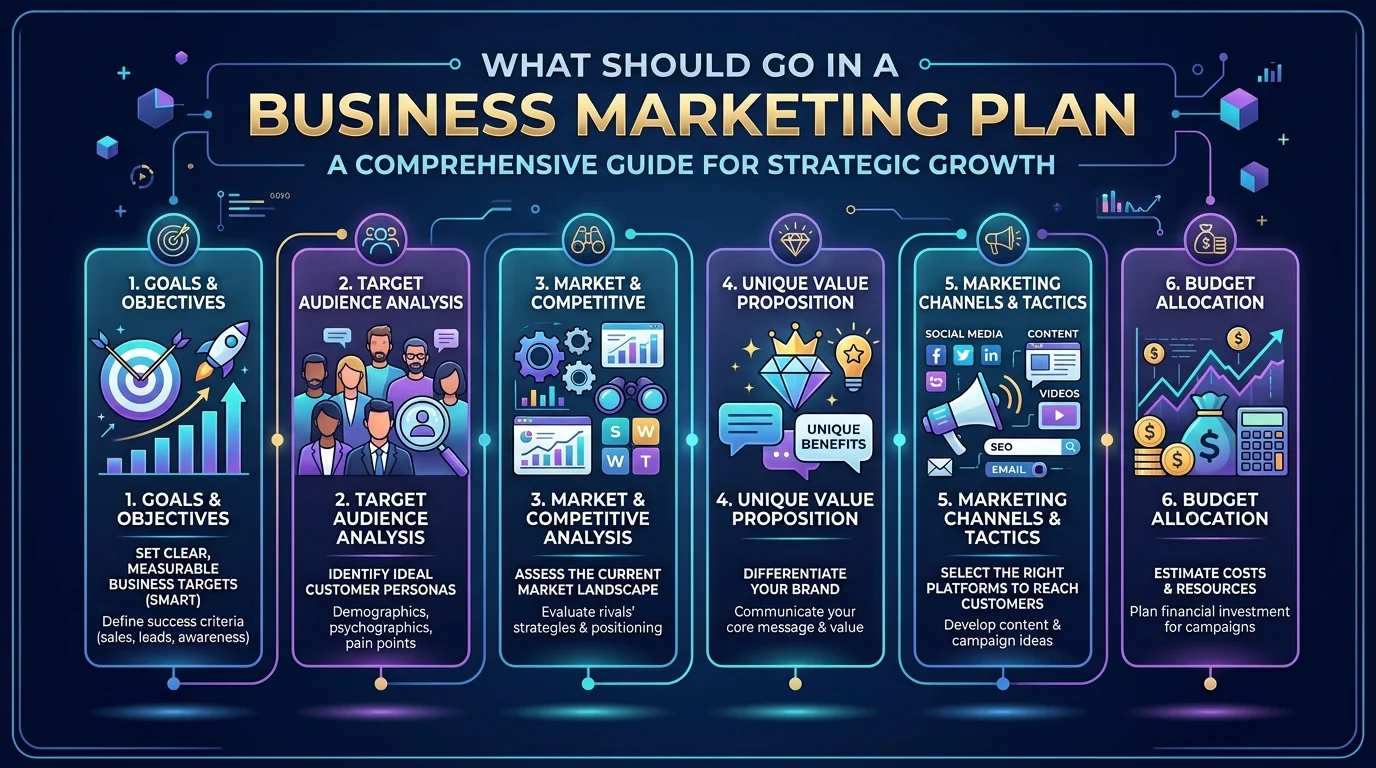
A marketing plan should include eight core sections: an executive summary, target audience and buyer personas, SMART goals, a competitive analysis, your marketing mix and channels, a budget, a timeline, and KPIs to measure success. Together, these sections turn a vague idea like "get more customers" into a document your friend can actually follow week to week.
So your friend just started a business, and now she's staring at a blank document wondering where to even begin with her marketing plan. I get it. I've watched dozens of founders freeze up at this exact stage, not because they lack ideas, but because nobody ever showed them the structure that works.
Here's the thing: a marketing plan isn't a fancy slide deck you make to impress investors. It's a working document. Something you'll actually open every week and use to make decisions. Let's break down exactly what needs to go into it.
What Is an Executive Summary in a Marketing Plan?
An executive summary is a short overview, usually two to three paragraphs, that covers what the business does, who it serves, and where marketing fits into the bigger picture.
Write it last, after every other section is done. That's when you'll actually know what you're summarizing. This part matters more than people realize. If she ever pitches this plan to a partner, a lender, or a new hire, the summary is what they read first, so it needs to stand on its own.
Who Is Your Target Audience?
This is where most plans fall apart before they even get going.
You cannot market to "everyone." A founder who tries to appeal to every possible customer usually ends up connecting with none of them. She needs a real target audience definition and, ideally, one or two detailed buyer personas.
A step-by-step guide from Asana recommends a bullseye targeting approach: narrow in by industry, location, company size, and demographics until you land on one specific, describable person.
Here's a quick way to build that persona:
Give them a name and an age
Write down their biggest daily frustration related to your product or service
Note where they spend time online
List what would make them trust a new brand enough to buy
Once this is nailed down, every other decision in the plan gets easier.
What Makes a Marketing Goal "SMART"?
A SMART goal is one that's specific, measurable, achievable, relevant, and time-bound. Vague goals like "get more customers" don't count, because there's nothing to track.
According to Improvado's 2026 marketing plan guide, the difference between "increase brand awareness" and "increase organic blog traffic by 20% in six months" is the difference between a wish and a plan she can act on.
Vague Goal | SMART Version |
|---|---|
Grow on social media | Gain 500 engaged Instagram followers in her local market within 90 days |
Get more customers | Convert 50 new customers from email campaigns by end of Q4 |
Improve the website | Increase blog-to-signup conversion rate from 2% to 4% in 6 months |
Build brand awareness | Reach 10,000 local impressions per month across paid social |
Small, trackable wins like these build real momentum, and momentum is what keeps a new business owner from giving up when things get slow.
Why Does a Competitive Analysis Matter?
Before locking in goals, she should look sideways at what competitors are already doing. A competitive analysis doesn't need to be complicated: name three to five direct competitors, note what they do well, and be honest about where they fall short. That gap is exactly where her business can plant a flag.
Which Marketing Channels Should a New Business Use?
Now for the fun part: deciding where she'll actually show up.
Your marketing mix is the combination of channels and tactics used to reach the audience defined earlier. Per Asana's marketing plan resource, this typically spans social media, email marketing, content strategy, and SEO working together rather than in isolation.
I'd tell her not to spread herself across six platforms on day one. Pick two, maybe three, and get genuinely good at them before adding more:
Email marketing for nurturing people who already know her brand
SEO and blog content for people actively searching for what she sells
Local partnerships if she has a physical or community-based business
Paid social ads once she has a small budget to test with
If she wants a broader primer before narrowing her channel mix, how to start digital marketing walks through the fundamentals of picking channels as a beginner. And once she's ready to staff this up, how to build a social media marketing team covers what that first hire or contractor should actually own.
How Much Should Go in the Marketing Budget?
This section trips up a lot of new founders because they either guess wildly or skip it entirely.
Her marketing budget doesn't need to be huge. It needs to be honest. List platforms, tools, and any ad spend, then map that against expected outcomes. This keeps expectations grounded and prevents overspending on tactics that aren't working, a mistake I've watched too many small businesses make.
Why a Timeline Keeps the Plan Honest
A plan without dates is just a list of good intentions.
She needs a rough marketing timeline that lays out major campaigns, launches, and content pushes across the next three to twelve months. If she's a solo founder, "owner" might just mean her, but writing it down still forces accountability.
How Do You Measure If a Marketing Plan Is Working?
Last, and honestly the most important piece: key performance indicators, or KPIs.
Website traffic, email signups, conversion rate, and customer acquisition cost are the numbers that tell the real story behind the vanity metrics. Per Business News Daily, a focused plan aims to both build customer loyalty and capture a specific slice of market share, and those two goals need their own separate metrics.
Marketing Plan Structure at a Glance
Section | What It Answers | Example |
|---|---|---|
Executive Summary | What is this plan about? | 2-3 paragraph overview |
Target Audience | Who are we selling to? | Buyer persona: "Marketing Molly, 35" |
SMART Goals | What does success look like? | "500 new followers in 90 days" |
Competitive Analysis | Who else is competing for this customer? | 3-5 named competitors, gaps identified |
Marketing Mix | Where will we show up? | Email + SEO + local partnerships |
Budget | What will it cost? | Tools, ad spend, platform fees |
Timeline | When does each piece happen? | 3-12 month campaign roadmap |
KPIs | How will we know it worked? | Traffic, signups, conversion rate, CAC |
Frequently Asked Questions
What are the 7 (or 8) sections of a marketing plan?
Executive summary, target audience, SMART goals, competitive analysis, marketing mix, budget, timeline, and KPIs.
How long should a marketing plan be for a small business?
Long enough to cover all eight sections with specifics, but short enough to actually get read and reused. Most small business plans run two to five pages.
How much should a new business budget for marketing?
It varies by industry and stage, but the key is mapping every dollar to a specific channel and expected outcome rather than picking a round number.
Do I need a marketing plan before launching?
Yes. Even a lean, one-page version helps her avoid marketing to "everyone" and wasting early budget on the wrong channels.
What's the difference between a marketing plan and a business plan?
A business plan covers the whole company, including finances and operations. A marketing plan is the section (or standalone document) focused specifically on how she'll find, convert, and keep customers.
Putting It All Together
None of this needs to be perfect on the first draft. What matters is that she writes it down, uses it, and revisits it every month or so as she learns what's actually working for her audience.
A marketing plan that lives in a drawer helps nobody. One that gets opened, argued with, and updated? That's the one that actually moves a new business forward.
Found this helpful? Share it with others who might benefit from these insights!
Submit Your AI Tool