

About Hiapi AI
HiAPI Review 2026: One API Key for Every AI Generation Model
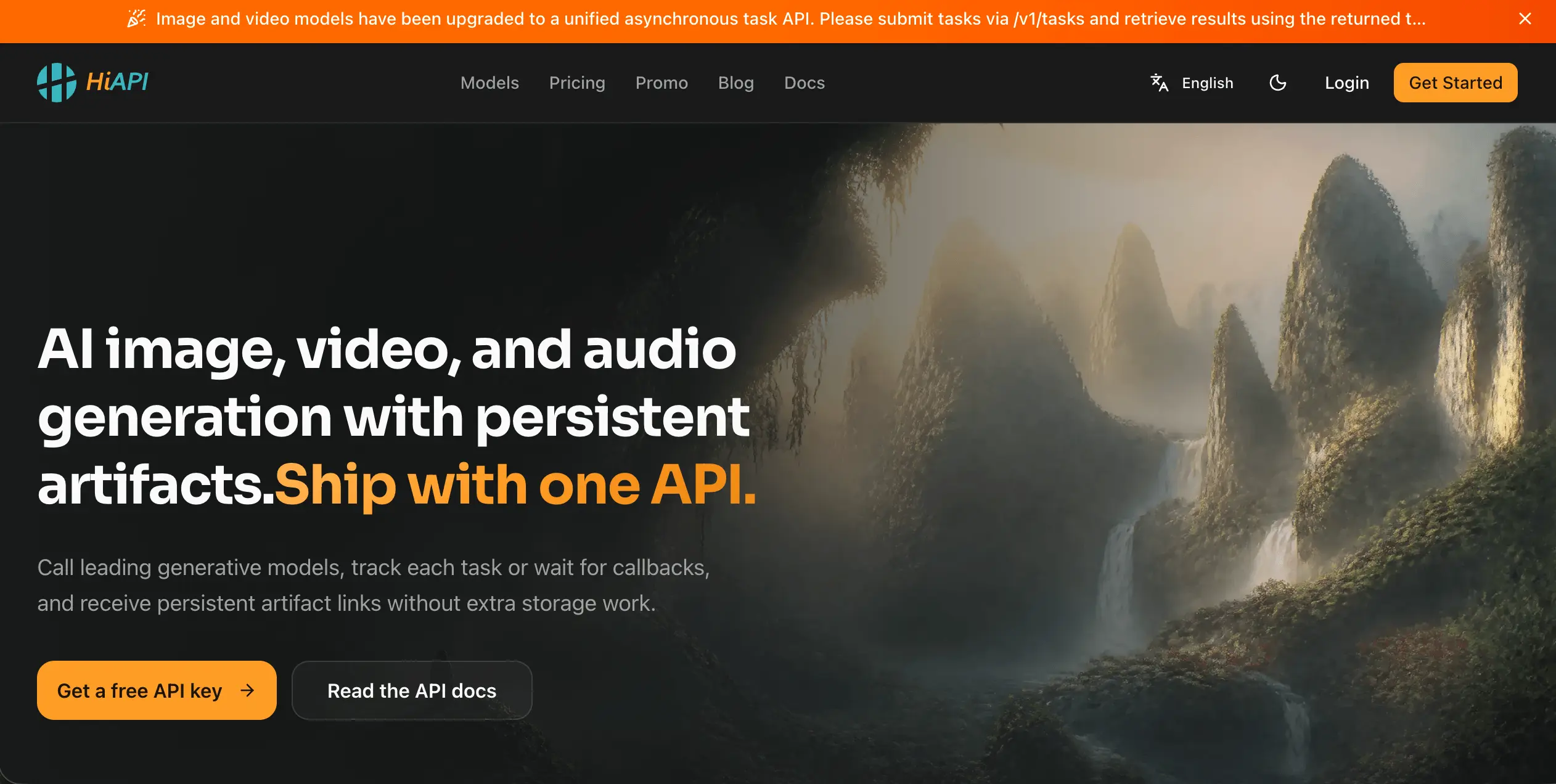
HiAPI is a unified AI API gateway that routes image, video, and audio generation requests to leading models from OpenAI, Google, ByteDance, Black Forest Labs, and Alibaba through a single endpoint, a single API key, and a single task-based schema. Developers submit a POST request to /v1/tasks, get back a task ID, and retrieve persistent artifact links without building their own storage. Pricing is flat per task with no token billing and no surge pricing. This review covers what HiAPI actually includes, how its pricing compares to building direct integrations, where it fits in a real developer workflow, and where it falls short.
What Is HiAPI?
HiAPI is a developer-first AI API platform. It aggregates image, video, and audio generation models from top providers into one RESTful API with one authentication key. Instead of managing separate API keys, different schemas, and storage infrastructure for each provider, developers make one call shape to one endpoint regardless of which model they are using.
The platform handles infrastructure, billing, and provider routing. Developers write one integration once and swap between models by changing a single model parameter.
This matters most for teams building AI-powered products that need to test across multiple generation models, switch providers without rewriting integration code, or run multiple model types (image, video, audio) inside the same application.
HiAPI Features
Unified Task API
Every model on HiAPI runs through the same async endpoint at /v1/tasks. The request shape stays consistent: model, input, optional storage, optional callback. One integration covers text-to-image, image-to-image, text-to-video, image-to-video, and audio generation.
Persistent Artifact Storage
Generated outputs come back as durable links. HiAPI stores them so developers do not need to build or maintain their own storage pipeline. For teams that have burned engineering time on building artifact storage for every new provider they integrate, this is a practical time saver.
Callbacks Instead of Polling
Developers can pass a callback URL in the request. HiAPI calls the URL when the task completes, which fits image and video workloads where generation takes 30 seconds to 2 minutes. This removes the need to write polling loops that check task status every few seconds.
Availability-First Routing
HiAPI routes requests for stable access, not cheapest available route. For production workloads where uptime matters more than squeezing the last cent out of per-task cost, this is the right priority.
MCP, Skills, and llms.txt Support
HiAPI publishes an MCP server, agent Skills, and an llms.txt file so AI agents (Claude, Cursor, Codex) can discover, call, and compose HiAPI workflows directly. Developers paste the llms.txt prompt into their agent and the agent picks the right setup path.
OpenAI-Compatible Endpoint
HiAPI offers a /v1/chat/completions endpoint for teams migrating from an existing OpenAI client. Migration is a base URL swap and a key swap with model name mapping.
Free Trial Credit
New accounts get $1 in free credit, roughly 50 images at the base resolution pricing. No credit card required to test.
Here are both sections rewritten without tables:
HiAPI Supported Models
HiAPI covers six production-ready models across image and video generation.
GPT Image 2 is OpenAI's image model, built for sharp text rendering and product photography. It handles English headlines, CJK calligraphy, and in-image labels correctly on the first generation. Pricing runs from $0.02 per image at 1K resolution up to $0.06 at 4K.
Nano Banana 2 runs on Google Gemini Flash. It generates fast with strong character consistency across outputs. Costs $0.05 per image.
FLUX 1.1 Pro from Black Forest Labs produces high-fidelity, detailed images with strong prompt adherence. The right pick for product visuals and detailed concept art. Costs $0.05 per image.
Qwen Image 2.0 is Alibaba's image model, covering high-quality generation and editing. It uses a DashScope-style nested schema with literal pixel sizes, so keep a model-specific payload adapter in your integration layer.
Seedance 2.0 from ByteDance generates cinematic video with native audio and multi-shot consistency. The most expensive model on the platform at up to $0.823 per 1080p clip, which reflects the compute cost of video generation.
HappyHorse 1.1 handles text-to-video, image-to-video, and reference-to-video workflows. Pricing varies by output length and resolution.
Every model above runs through the same /v1/tasks endpoint with the same request shape. Switch between them by changing the model parameter.
HiAPI Pricing
HiAPI charges flat per task. No token billing. No surge pricing.
GPT Image 2 (beta) costs $0.02 per image at 1K resolution. The standard GPT Image 2 runs $0.03 at 1K, approximately $0.04 at 2K, and $0.06 at 4K. Most production use cases, product mockups, social posts, quick prototypes, sit comfortably at 1K or 2K without needing the 4K tier.
FLUX 1.1 Pro and Nano Banana 2 both cost $0.05 per image at standard resolution. Straightforward flat rate with no resolution tiers to manage.
Seedance 2.0 video generation costs up to $0.823 per 1080p clip. This is the platform's most expensive task type, reflecting the GPU cost of full video generation with native audio.
Three practical levers reduce cost per run: drop to a lower resolution tier where quality allows, reuse similar prompts to hit the cache, and batch related generations together rather than running them individually. Volume discounts are available for larger usage through direct contact with the HiAPI sales team.
Who Should Use HiAPI
HiAPI is the right pick for three specific teams.
AI SaaS builders who need to test across image and video models quickly, keep generated assets reachable without building a storage path for every provider, and want to swap between models without rewriting integration code.
Creative automation teams building pipelines where generated outputs pass between campaign tools, review workflows, and downstream automation. Persistent artifact links make this straightforward. Without them, teams build custom storage for every provider they integrate.
Agent workflow developers building with Claude, Cursor, Codex, or similar agents that need to request, wait for, retrieve, and reuse generated media inside automated pipelines. HiAPI's async task API with callbacks gives agents a clean interface for this pattern.
HiAPI is not the right pick for developers who need the widest possible open-source model catalog, teams with specific compliance requirements around data routing, or individuals running one-off personal projects where the $1 free credit covers everything they need.
Frequently Asked Questions
What is HiAPI?
HiAPI is a unified AI API gateway that gives developers one endpoint and one API key to access image, video, and audio generation models from OpenAI, Google, ByteDance, Black Forest Labs, and Alibaba. It handles infrastructure, billing, and provider routing so developers write one integration instead of managing separate APIs for each provider.
Is HiAPI free?
HiAPI offers $1 in free credit on sign-up, which covers roughly 50 images at base resolution. No credit card is required to start. After the free credit, pricing is pay-per-task with no monthly fees or subscriptions.
How does HiAPI pricing work?
HiAPI charges a flat rate per task. GPT Image 2 starts at $0.02 per image at 1K resolution. FLUX 1.1 Pro and Nano Banana 2 cost $0.05 per image. Seedance 2.0 video generation costs up to $0.823 per 1080p clip. There is no token billing and no surge pricing.
What models does HiAPI support?
HiAPI supports GPT Image 2, Nano Banana 2 (Gemini Flash), FLUX 1.1 Pro, Qwen Image 2.0, Seedance 2.0, and HappyHorse 1.1, with more models added regularly. Every model runs through the same /v1/tasks endpoint.
How do HiAPI persistent artifacts work?
When you include "storage": "persistent" in a task request, HiAPI stores the generated output and returns a durable link. The link stays reachable without you building or maintaining your own storage pipeline. This is useful for pipelines where outputs pass between tools or agents.
Can AI agents use HiAPI?
Yes. HiAPI publishes an MCP server, agent Skills, and an llms.txt file. Developers paste the llms.txt prompt into agents like Claude, Cursor, or Codex, and the agent picks the right setup path between Skills, Remote MCP, or direct API integration.
Where can I compare HiAPI with other AI API platforms?
Compare HiAPI side-by-side with other AI API platforms at aitoolsync. AIToolSync's comparison engine is free and covers features, pricing, pros, cons, and use case recommendations across 1,000+ verified AI tools.
Verdict
HiAPI solves a real problem for development teams building multi-model AI applications. Managing separate API keys, schemas, and storage pipelines for OpenAI, Google, ByteDance, and Black Forest Labs separately adds engineering overhead that compounds as the model count grows. HiAPI collapses that into one key, one endpoint, and one task schema with persistent artifact storage built in.
It is not the right pick for every developer. Teams that need the widest open-source model catalog will find more options on Replicate. Teams with the engineering bandwidth to build and maintain direct integrations will pay slightly less per task going direct.
For AI SaaS teams, creative automation pipelines, and agent workflow developers who want to ship faster without rebuilding storage and integration infrastructure for every new provider, HiAPI is worth the per-task markup.
What you can do with it
Pros & cons
Synthesised from user reviews and hands-on testing. No tool is perfect — here's where each shines and where it stumbles.
- One API key, one endpoint, one schema for all image, video, and audio models
- Persistent artifact storage included, no storage infrastructure to build
- Flat per-task pricing with no token billing, no surge pricing
- Callbacks remove the need to write polling loops for long-running jobs
- OpenAI-compatible endpoint makes migration from existing clients fast
- MCP and llms.txt support for AI agent workflows out of the box
- $1 free credit to test real generations before paying
- Availability-first routing prioritizes uptime over cheapest route
- 24/7 support for production integration
- Smaller model catalog than Replicate for open-source model experimentation
- Per-task cost carries a small markup compared to going direct to each provider
- Qwen Image 2.0 uses a different nested schema (DashScope style) requiring a model-specific payload adapter
- GPT Image 2 generation averages 107 seconds per image, which is slower than its predecessor
- No transparent background support in GPT Image 2 (requires a separate background remover for PNG cutouts)
- Volume discount terms require contacting sales, not self-serve